

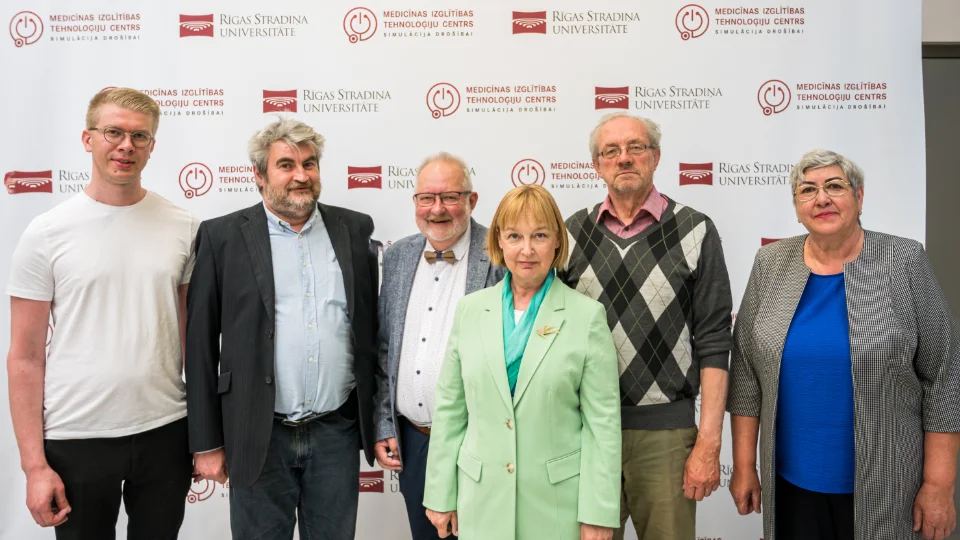
Written by Martins Valters
We are an extraordinary generation! We – the pensioners of our time – are a remarkable bunch. Born in an era devoid of television, I recall the days when a neighbour’s TV was a nightly marvel for the entire household. It wasn’t long before TVs became commonplace, and then, behold, colour TV emerged. Telephone communications have undergone similar transformations. Once, we called places hoping to find the person we needed; now, we call specific individuals and can not only talk to but also see them.
Many of our descendants live abroad, yet we yearn to stay connected. Thanks to modern technology, this is neither impossible nor expensive if we know how to use IT. My son’s first steps were towards the TV. My grandson’s first steps were towards the computer. My great-grandson isn’t walking yet, but he can already find his favourite cartoons on his father’s smartphone.
No one has ever taught anyone anything! A person either learns on their own or remains as they were. The most talented teacher, the most brilliant professor, can only assist those who are willing to learn on their own. We weren’t taught how to handle television at school; we learned it ourselves. We weren’t taught how to handle computers or smartphones; we learned it ourselves. We are a generation that has had to learn continuously because life doesn’t just move forward – it races ahead.
Many of us already know how to use modern technologies. But did you know:
- You can use programs like Microsoft Word, Excel, and Outlook for free?
- These free programs are available in your native language, so there’s no need to struggle with commands in English.
- You can read CNN, BBC, and even Chinese news in your native language?
- You can watch many YouTube videos with subtitles in your native language?
You can learn these and many other practical skills using the training materials developed in the project “Age is not an obstacle III”. These materials are especially suitable for self-study. The project covers 24 different online programs from Microsoft and Google, all available in Baltic languages.
Here is the list:
- Microsoft OneDrive, Edge, Outlook, Teams, Word, Excel, PowerPoint.
- Google Disk, Chrome, Advanced Search, Gmail, Calendar, Meet, Translate, Maps YouTube, Docs, Sheets, Slides, Photos, Forms, Travel, Arts & Culture
- WhatsApp Desktop
The project team, consisting of Latvians, Lithuanians, and Estonians, has developed training materials – presentations, explanatory texts, and video materials – to make it easier for you to learn and use these programs according to your needs. But remember, you have to learn yourself! You will be able to choose which programs are most important to you and master them first.
The training materials in native Baltic languages are published on the project websites (materials are available for free):
Products and materials
The project developed learning materials that include a course description, presentation, text with additional information and video tutorials on 24 topics. All materials were developed in English, edited and then translated into Latvian, Lithuanian and Estonian languages. All materials in national languages are published on the project’s websites. More than 700 persons were registered for self-learning and on-line consultations.
Age is not an obstacle IV – Artificial Intellect Serving Seniors proposal
A new application in this series of projects is already submitted and we hope it will be supported by NPAD. The objective of the current project is to develop training materials for self-learning for seniors to use advantages of AI in their daily routine in 12 different life situations.
It is obvious that ability to use different applications and AI will become crucial survival factor in the near future. For this reason, it is urgent to provide relevant training for seniors and individuals who have pre-retired.
Future partnerships in Scandinavia
We would appreciate new partners from Scandinavian countries willing to devote their time and effort to contribute to the development of new and improvement of existing training materials and methods. We propose to develop applications for the NPAD call 2026. Organisations interested to join in partnership are invited to contact me – Martins Valters – via email: martinsw@latnet.lv.