Norway
Occupational profiles help to identify basic skills for educators
The Norwegian Directorate for Higher Education and Skills has created basic skills profiles for a variety of occupations. These profiles help to identify and reinforce key competencies such as reading, writing, and digital skills in working life.
The Norwegian Directorate for Higher Education and Skills has created skills profiles for a variety of industries. These profiles are based on the competencies of being able to read, write and count, as well as having oral and digital skills. These are the skills necessary in order to succeed in different occupations and to continue learning throughout working life. The profiles provide examples of the skills and competencies that an individual must bring to a given occupation or industry.
Profiles provide an indication of training needs
The Directorate has created profiles for more than thirty occupations and industries.
“For instance, these include the profile of a nursery school assistant, which for some people can be their entry into the world of work,” says Tanja Aas, senior adviser at the Norwegian Directorate for Higher Education and Skills.
Other roles that they have created profiles for include car mechanic, plumber, hairdresser and bus driver. However, there are also profiles relating to leisure activities and voluntary roles.
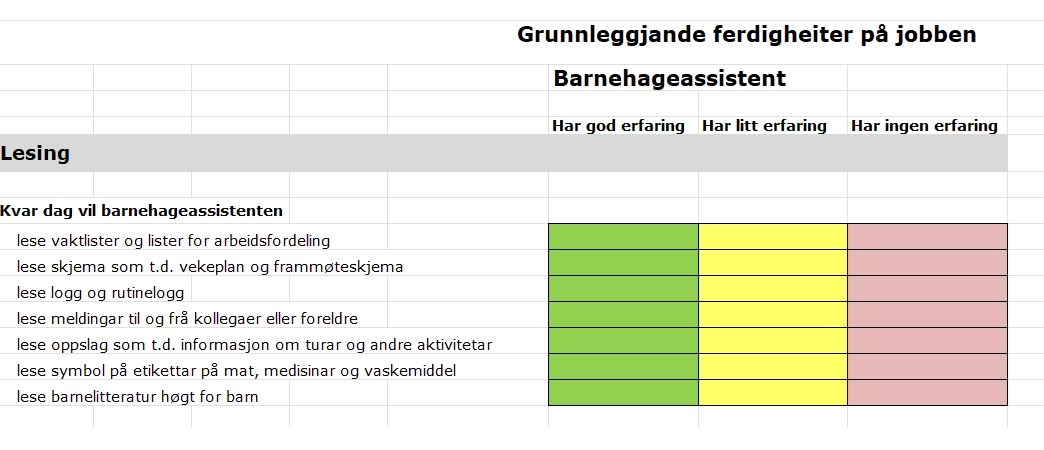
The profile for a nursery school assistant sets out that the individual is expected – on a daily basis – to read lists about the division of tasks, to read forms, weekly schedules and registers, and to deal with work-related logs.
These are practical skills that an individual must possess in order to be able to manage their daily work at a nursery school.
The profiles are intended for use in educational and training settings to facilitate conversations with students about the training opportunities that are available and the requirements that will be demanded of them in working life, as well as allowing for the adaptation of courses to meet an individual’s needs. These materials can also be used by employers who want to gain an understanding of which general skills need to be bolstered in different occupations. Tanja Aas adds that the profiles are used in many different contexts, including in prisons.
”
Oral competence isn’t about being able to speak Norwegian or being good at talking – it’s about knowing who to talk to. And what to talk about with whom,” says Tanja Aas, senior adviser at the Norwegian Directorate for Higher Education and Skills.
Profiles available in different languages
“Initially, we were only going to offer the profiles in the two written standards of Norwegian (Bokmål and Nynorsk) plus Sámi. We only have a few occupational profiles available in Sámi. We also offer them in English since we are members of a wide variety of Nordic and European networks – and we now offer them in Ukrainian as Norway has taken in 70,000 Ukrainians since 2022,” says Tanja Aas.
The profiles are available in two versions: one is a text-based document and the other is an Excel spreadsheet that people can use to assess their own skills. During the self-assessment, individuals must indicate whether they have lots of experience, little experience or no experience of performing each task.
This approach using occupational profiles was inspired by similar schemes in Canada and New Zealand.
Oral competence
Oral competence is not just about being verbal, talkative or being able to conduct a conversation.
It isn’t about being able to speak Norwegian or being good at talking – it’s about knowing who to talk to. And what to talk about with whom. When we’re referring to basic skills, oral competence can be about explaining that you’re running five minutes late for a meeting with your friends or a job interview,” says Tanja Aas.
Oral skills also include a degree of social skills. For example, the profile for a nursery school assistant sets out that the individual must be able to coordinate daily work with their colleagues and discuss suitable actions to respond to unexpected situations.
Reading skills checklist for nursery school assistant (Swedish)
Digitalisation requires the ability to read
Something that becomes obvious when reviewing the profiles is the way in which roles that at first glance seem practical in nature in fact include many duties that require the employee to be reasonably good at reading and writing. Tanja explains that this is the result of digitalisation.
“The truth is that in every place of work, regardless of whether you work out on the floor or you’re higher up in the hierarchy, the more digital the environment becomes, the more reading there is to be done.
What was once disseminated verbally is now read via the intranet,” says Tanja Aas.
The profiles demonstrate how training and skills development can be adapted to meet the needs of the workplace. They also show just how important general skills are, regardless of occupation.
Link
Profiles of basic skills on Norwegian Directorate for Higher Education and Skills website.
https://hkdir.no/voksenopplaering/opplaering-i-grunnleggende-ferdigheter/profiler-for-grunnleggende-ferdigheter
https://hkdir.no/voksenopplaering/opplaering-i-grunnleggende-ferdigheter/profiler-for-grunnleggende-ferdigheter