4. Good Practice Cases – MCs in a Nordic perspective
4.1. Analytical approach and focal points
4.1.1. Model for case description
The cases have been selected with a focus on the inclusion of themes and aspects, which are estimated to support added value and benefits for end-users and thus valued as Good Practice Cases.
The cases for this purpose are described by a combination of mapping findings, examples and categories. Together, the individual cases form core units for the analysis as they also provide a coherent and firm basis for Recommendations on the development of MCs.
NLL partners have selected the cases for description, based on a developed model with a three-part structure:
A WHAT section, a How section and a WHY section. The three-part structure provides case descriptions, applicable for explaining content and mechanisms of the MC to ensure the intended results, added value and benefits for end-users.
The cases provide a complexity of knowledge and understanding of development, provision, application and benefits of the specific MC, while addressing the WHAT, HOW and WHY questions:
The aim of the WHAT section is to provide an understanding of WHAT constitutes frameworks, conditions, context and so on for this specific MC – or in other words: to set the stage for a closer exploration of the MC.
The aim of the HOW section is to provide an understanding of HOW the MC in terms of content, aim, application, methods and so on is developed.
Together, these two previous sections form the basis for description of WHY the expected results of added value, benefits of end-users are considered likely to be achieved by the user.
Thus, the cases demonstrate coherent perspectives and indicators, identified in terms of single perspectives and aspects from the mapping examples while also contributing to reflect the analysis of cases within coherent multi-perspectives.
The cases are analysed based on an assessment of two questions:
- Benefits and challenges
- Possibilities of further development
Both questions are relevant for assessing the two key focal points of the study:
- Added value of the MCs
- Benefits for end-users
The analysis of cases takes place with the application of 1) Models of Coherent Factors and 2) National context descriptions.
4.1.2. Models for Coherent Factors
Three models have been developed for the illustration of built-in complexities in the development, application and achievement of benefits of MCs.
The primary focus of each of the three models is:
- The Learner
- Legitimacy and trust
- Transparency and reference to systems
The models of Coherent Factors are constructed by themes from the mapping matrix (chapter 3.2.). The models provide an analytical frame for the cases and, together, they form a consistent starting point for identification of Recommendations for development of MCs.
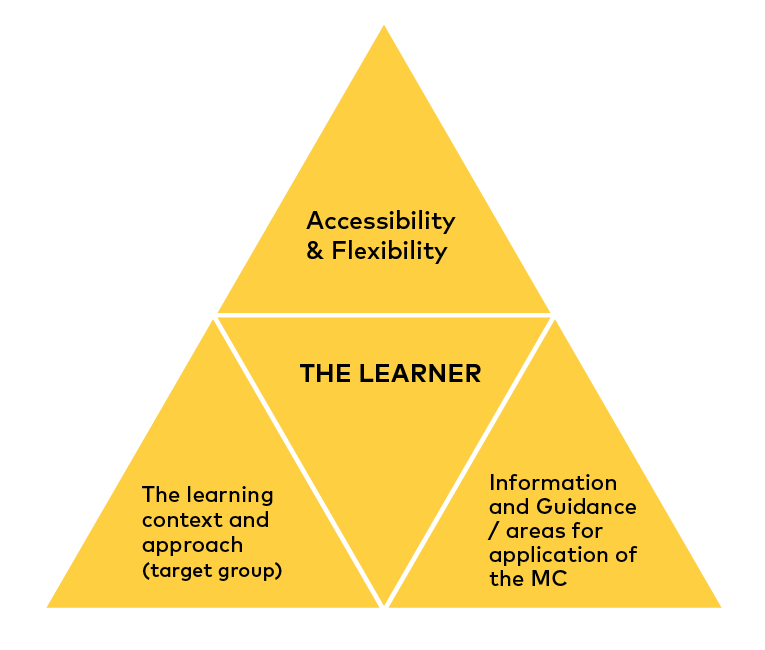
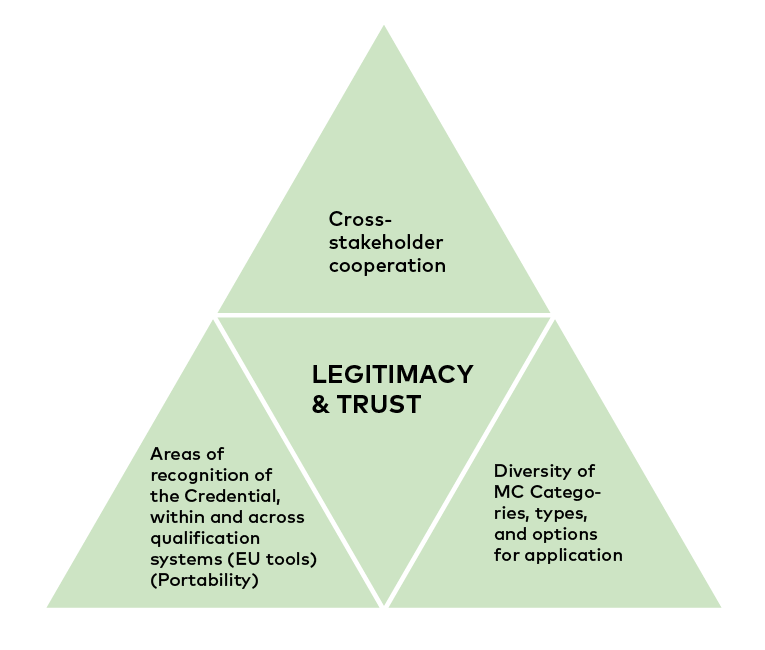
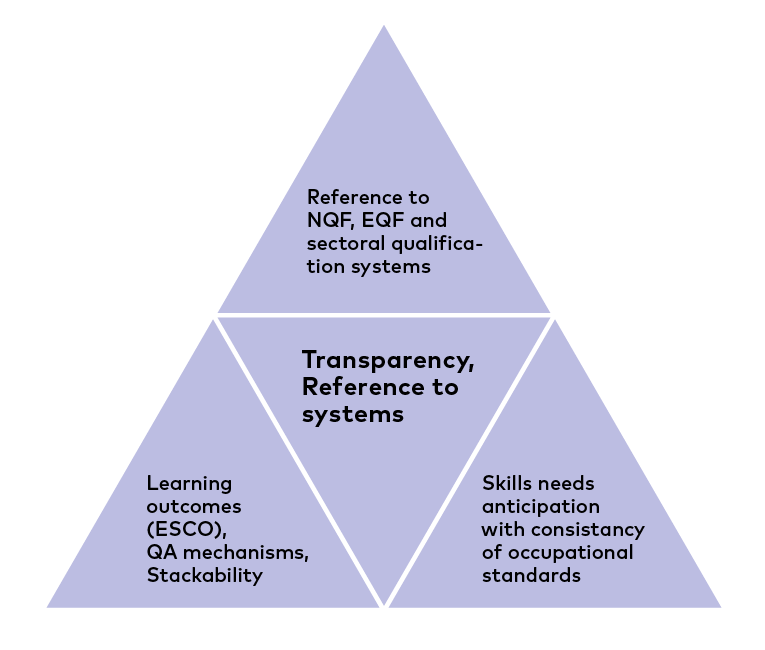
Figure 4. The models of Coherent Factors.
.
4.1.3. National Context Descriptions
For each NLL partner country and self-governing region, an introduction about the national context for MCs is provided with a short description of what has or could have an impact on the opportunities for further development and proliferation of MCs. A special element of the context descriptions are new national initiatives for MC in combination with legal frameworks, NQFs and other support structures.
National context descriptions (chapter 3.6.) thus provide a resource for the analysis of cases – as well as for the development of the Recommendations.
4.2. Good Practice Cases – overview
No. | Title | Country | Category |
1. | Upskilling by MC to industrial technician | DK | Category 2. MCs applied for formal education and training |
2. | Formal and non-formal short courses | FO | Category 2. MC, linked to formal education, individually or in new settings, for upskilling, reskilling of retention. Stackable to a full qualification |
3. | National badges for basic skills | FI | Category 3. MC for validation of non-formal learning |
4. | Learning labs for young people | GL | Category 1. MC in Validation and recognition of skills and competences for inclusion (access to education and/or job) |
5. | Professional Certificate for Work Life | IS | Category 2. MC in Validation and recognition of skills and competences for upskilling or reskilling (for jobs and education). |
6. | Circular Economy | NO | Category 4. MC for Twin Transition |
7. | MC for safety and security skills | SE | Category 1. Microcredentials for assessment of skills, non-formal. |
8. | Upskilling to elderly care | SE | Category 2. MC, linked to formal education, individually or in new settings, for upskilling, reskilling of retention. Stackable to a full qualification |
9. | OCN for young people, Åland | AX | Category 1. MC in Validation and recognition of skills and competencer for inclusion (access to education and/or job) |
Figure 4. Good Practice Cases – overview
4.3. Analysis of Good Practice Cases
Case 1: Denmark
Upskilling by MCs to industrial technician (category 2)
What
EUC-Nord is a Vocational Education and Training Institution in Northern Jutland. EUC-Nord caters to young people and adult learners with VET programmes and Adult Vocational Education and Training (AMU). EUC-Nord has collaborated with a local company to develop a flexible educational programme consisting of several MCs targeted at a specific group of employees upskilling to become an industrial technician. The entire programme can take up to 40 weeks to complete, but many employees can receive shortenings for parts of the programme. The employees already work at the company but are classified as unskilled. They have various educational backgrounds from other industries but currently they work as unskilled employees in the specific company. Through a Validation of Prior Learning process (in Danmark, RKV), employees’ skills and competencies have been mapped as to formal, non-formal, and informal skills. Several employees have received shortening for parts of the training programme, allowing them to participate in a programme lasting for about 20 weeks.
How
The company needs to retain a qualified workforce. While located in a peripheral area of Northern Jutland, attracting skilled industrial technicians can be challenging. The programme targets employees with education and experience from other Industries. It’s an opportunity for the employees to obtain a certification as an industrial technician. This Vocational Education is valued both by the specific company and within the industry.
Why
Through an educational agreement with the company and the employees, EUC-Nord has organised a flexible programme where employees participate in theoretical training at EUC-Nord and practical training at the company. All parts of the programme are provided as short-defined education units that can be tested and completed along the way. A primary point is stackability because it allows employees to join the training program whenever it is possible to participate. Between 20–25 employees have completed the programme so far, with high satisfaction from all three parties.
Benefits and challenges
The flexible model for upskilling to industrial technician can be beneficial for both the employee and the employer/the company
For the Employee
- Visibility of competences, recognised skills and knowledge
- Flexibility and individualisation can be motivating for education
- Parts of the education programme are carried out at the workplace
- Motivation for learning in the workplace and for job development
- Mobility in the labour market
For the Company
- Flexibility of the model accommodates requirements for work planning in daily production
- The education is based on actual as well as future skills requirements for the company and the sector
- The model, based on VPL for each participant, allows for shortening of the entire duration of the education thus making the upskilling process more manageable for the company
- Retention as well as recruitment of new employees is optimised especially in areas of recruitment difficulties
- Possibly increase of learning culture in the company after the upskilling of employees eventually for innovation in production performance
Possibilities of further development for added value and benefits for end-users
The Danish Qualification Framework is not open for non-formal learning. Legal framework for VPL (in Denmark RKV) is carried out in relation to formal education. This means that non-formal and informal learning is not formally recognised. However, recently (2022) the NQF has been opened for level assessment of private education programmes. Maybe this forms a first step.
The benefits of having non-formal learning recognised could have a significant impact on learning motivation – from both employer and employee perspectives and thus contribute to a general motivation for lifelong learning.
Based on skills needs forecasts at sector level, more attractive job opportunities could improve recruitment as well as mobility across industries in step with further development of flexible and individualised educational models.
The high degree of flexibility
All MCs are short-defined education units that can be tested and completed along the way. A primary point is stackability because it allows employees to join the training programme whenever possible to participate. Hence, this aspect of accessibility for both employees and company addresses a frequently expressed criticism of formal education provision for being less flexible.
For end-users – the Employees, the Company and the Local Industries, benefits are regarded in terms of the positive perspectives of the model to be applied also in other areas and industries. Thus, providing impacts concerning:
- The image of interesting jobs with development perspectives
- A general upskilling of workforce with a positive impact on the individual user’s self-confidence and job-security and with a possible increase of motivation for learning
- For the company an increase of skill and competence level with a possible impact on innovation in business
- For the regional labour market, there is a positive impact on the labour market skills balance
Case 2: the Faroe Islands
Formal and non-formal small courses (category 2)
WHAT
Title: “Come and sign the Faroe Islands”
Target group: Unemployed people, registered as unemployed in the Employment Agency (ALS – Arbeiðsloysisskipanin).
Context for development: strengthen skills development aimed at the labour market
The small courses are demand-driven, the initiative comes from the Office for Unemployed (ALS), aimed for the Tourism Branch (based on skills needs identification)
Context for provision, the employment agency (ALS) is preparing, implementing and providing the course, the Employment Agency (ALS) selects unemployed people from their client list to participate in the course.
The courses are developed as small size courses/MCs of 15 weeks, each of 30 hours. ECTS are not associated with the MCs. They are stand-alone, combined into a series and include practical tasks.
Information is provided by the job counsellor at the Employment Agency (ALS)
HOW
Approach and learning context: The courses are provided face to face, in classrooms and out in the field of practice. The focus is on the labour market (to give people a new job) and education, and the learning context is classroom teaching and field learning with different teachers and professional skilled workers.
QA standards and tools are ensured in terms of job standards and best practice.
Learning outcomes for the small courses are described in terms of:
- Knowledge about sustainable tourism
- Knowledge and skills in English for tourism
- Service skills in the tourism sector
- Skills and knowledge in project work
- Skills in teamworking and collaboration
- Garuda personal test and interview about further opportunities based on the Garuda test
- Knowledge about how to write applications, making a CV and having a job interview
- Practical working skills to make signs and find out places in the Faroe Islands that need information signs for tourists
- Skills in making movies, video and audio cutting for documentation
Assessment & recognition; There is no formal assessment.
WHY
Expected outcome / benefit for end-users. After completion of the MCs, the individual is more certain about how to seek a job or choose education or further skill and competence development. The individual gains a better knowledge about the Faroe Islands from a tourist perspective.
Stakeholders involved: There are many stakeholders involved: municipality, travelling agencies, visiting centres, museums, education institutions, hotels etc.
Credential system, Portability and stackability:
No formal credential is issued, however based on the learning, the individual obtains skills and competences that are useful for different job sectors. These types of small courses or MCs are not aimed at being stackable even if it should be possible to make them as such.
Evidence for benefits for end-users. It is not possible yet to find evidence for this, there is no ECO-system for MCs and no consistent system either.
Stakeholders are involved, but the course is not connected to a recognised credential system. However, there is a VPL system for validation of both theoretical and practical experiences in connection with further education.
A Faroese NQF is not yet available.
Benefits and challenges
For the learner
- Learning outcomes are defined in terms of key areas of identified knowledge and skills requirements for the branch and areas for personal development, as the series of non-formal MCs are aimed at both. They are combined in a pedagogical approach and tested – or evaluated during the courses.
- For further application of the acquired skills and development, future perspectives of job or education, it might form a challenge that no credential is issued after completion of the courses. The courses are non-formal and hence, there may be obstacles to benefiting from what has been learned while later applying for formal education.
- The context for development of the small courses and the provision in terms of the Faroes Public Employment Agency, (ALS) act as the guarantee for target group’s access to information and guidance, as well as QA is secured in terms of involvement of stakeholders, relevant for job standards and identification of best practice for the branch of tourism.
For the branch
- The model constitutes a strong coherence of perspectives: target group, purpose and course aim, stakeholder involvement, the focus on the branch addressed with identification of skills needs and learning outcomes. This consistency is of key importance for the success of the small courses.
- The cross-stakeholder involvement in development as well as for the practical training parts of the courses, assures that essential skills and knowledge for the branch are identified and built into aim of learning and the description of learning outcomes.
Possibilities of further development for added value and benefits for end-users
The model, aimed for supporting unemployed people to find job or to access education is based on non-formal learning. Education institutions are not involved in the provision of teaching.
Approach and learning context: The courses are provided in person, in classrooms and out in the field of practice. The focus is on the labour market (to help people get a new job) and education, and the learning context is classroom teaching and field learning with different teachers and professional skilled workers. This blended learning contexts opens for meeting individuals’ various learning preferences.
There is no formal assessment connected to the achievement of learning results, and no credential is issued.
Together, the possibilities of further development could be to develop a credential in one or the other format – to give the person a possibility to document achieved skills and knowledge. As the model is not based on formal assessment and recognition, the credential/document could have the form of a testimony provided by counsellor and teacher for the individual person.
As an initiative aimed for inclusion of unemployed to job or education, the model is placed in between two sectors – unemployment and job and education. The model could be broadened out to potentially all branches. If so, one point for further development could be to include an education institution in the cross-stakeholder collaboration to pave the way for VLP for an education perspective.
As this model is dedicated to initiatives for supporting unemployed people in their inclusion to labour market and education, the question of added value is regarded in terms of the model structure of small courses in a blended learning environment. The model does not provide formal learning with the possibility of having this assessed against formal education standards and criteria. However, the strong stakeholder cooperation secures a relevant and consistent focus on skills required for the Tourism branch with Quality Assurance in terms of job standards and best practice.
No formal credential is issued, however based on the learning, the individual obtains skills and competences that are useful for different jobs and branches. This should be documented in some kind of credential to contribute to the achievement of benefits for the end-users – the individual and the employer.
While formal recognition of achieved learning outcomes is not part of the model, an assumption from a Lifelong Learning perspective could be that no formalisation of recognition is not necessarily an obstacle for the achievement of benefits by the learner. First and foremost, the benefit should be to support the unemployed persons in gaining self-esteem and motivation for job and or education – as for the next steps on their leaning pathway.
Case 3: Finland
National badges for basic skills (category 3)
WHAT
Badges for basic skills are meant for adult learners and described to help people improve their basic skills. The National Agency for Education is the developer of badges, in co-operation with liberal adult education institutions and NGOs. Badges are based on EU framework for key competencies and basic skills. The expectation is that people who are interested in and would benefit the most from getting recognition for their basic skills are unemployed or otherwise in a disadvantaged position in the labour market.
Badges can only be provided by liberal adult learning institutions. Learners can demonstrate their skills in courses or in other ways. Badges are rewarded after learners have met the set criteria. The database enables individuals to showcase their accumulated learning via a personal account (studyinfo.fi).
Skills need identification: Badges for basic skills are based on supply-driven approach. Key competences and basic skills are needed by all for personal fulfilment and development, employability, social inclusion and active citizenship. The Council of the European Union adopted a recommendation on key competences for lifelong learning in May 2018. The recommendation identifies eight key competences essential to citizens for personal fulfilment, a healthy and sustainable lifestyle, employability, active citizenship and social inclusion. The council’s recommendations have been a source of inspiration for developing badges.
Purpose: In Finland, there are significant numbers of adult learners without necessary basic skills. At the same time, there is a lack of methods to validate transferable skills of adults. Multiple ways to learn and demonstrate basic skills are needed.
The badges are provided by the Adult Liberal Institutions. Regarded as MCs, they are stand-alone, organised due to key areas.
At the liberal adult education institutions, badges are rewarded after achieving set criterion. Skills demonstrations can be organised as part of a course, or as special demonstration events or days. The assessors or organisers have autonomy in organising demonstrations on the fit for purpose approach.
Target groups are defined as Adult Learners.
Information and guidance: The learner is informed about the process before the evaluation. The badge system allows individual choice of badges, if trainer/assessor has resources to accommodate personal learning pathways.
HOW
There are multiple ways to achieve a badge in basic skills. This can be done online, face-to-face or in a hybrid setting.
QA – standards and tools, Badges are based on competency-based approach, which has not been tradition in liberal adult education. The badge criteria are described in an equal manner as formal education, allowing transparency and comparability between educational sectors. It was decided that these badges are not referenced to a certain level or ECTS.
Assessment & recognition: The Finnish National Qualification Framework is not open for non-formal/informal learning. Right now, there is no data available if the badges are recognised by employers or education providers.
WHY
Expected outcome/benefit for end-users, there is little information from the individuals’ viewpoint of the benefits, but in general it can be said that making all competences visible can benefit the individuals in many ways in the labour market, formal studies or as a means for personal development. The database enables individuals to showcase their accumulated learning via a personal account (studyinfo.fi).
Transparency: The national learning database KOSKI provides the opportunity to Liberal Adult Education institutions to make learning outcomes gained through their courses or programmes visible in the database. This is also the case with badges for basic skills. Learner shows skills in courses or in other ways and can achieve badges (after assessment), if the set criteria are met. Badges can be seen in learners personal account in connection with all other educations (studyinfo.fi).
Benefits and challenges
For the learner
- Possibility of making basic skills visible
- Accessibility in terms of various forms of attendance –and supported by teachers and counsellors, considering the individual’s learning preferences
- Trust and legitimacy to the documentation is secured in terms of the developer of badges, National Agency of Education, in collaboration with the provider, Adult Liberal Education Institutions and NGOs
- Demonstration and documentation of skills are based on EU Framework for 8 Key Competencies and basic skills
- Badges are issued to the learner, when set criteria are met
- Regarded as MCs, they are stand-alone, organised due to key areas. Thus, of great importance for relevance and flexibility purposes, because the issued badges clearly address competences, relevant for key areas as well as the model offers an ongoing process of demonstration of basic skills and key competences
- The National Learning Database, KOSKI enables individuals to showcase their accumulated learning via a personal account (studyinfo.fi)
For the Liberal Adult Learning Institution
- The provision of a sustainable model for Liberal Adult Education Institutions is further qualifying for the institutions’ image, learning activities, and support of their learners
- The badges are based on a competency-based approach, which has not been a tradition in liberal adult education. The badge criteria are described in an equal manner as formal education, allowing transparency and comparability between educational sectors. It is a decision, that these badges are not referenced to a certain level or ECTS
- The model adds an important dimension to the credibility of adult learning institutions as to the contribution of models for sustainability of Lifelong Learning and social inclusion
- The Sector of Liberal Adult Education achieves a clear position within the context of other education areas, social institutions and labour market
Possibilities of further development of added value and benefits for end-users
The model is estimated to possess the consistency in development and provision, required for the possible achievement of benefits: relevant stakeholder involvement, legitimacy in terms of key competencies and basic skills frameworks. Furthermore, various forms of attendance for the learning secures the accessibility, preferred by the individual learner. Portability of the issued badge is secured in terms of storage at the National Learning Platform, KOSKI, in learner’s individual account.
Badges are based on a competency-based approach, which has not been tradition in liberal adult education. The badge criteria are described in an equal manner as formal education, allowing transparency and comparability between educational sectors. It was decided that these badges are not referenced to a certain level or ECTS.
The Finnish Qualification Framework is not open for non-formal learning. However, if this happens in the future, level of ECTS to the issued badges could form an asset for application to formal education, thus further improving coherency of learning and education areas. Another option – if national Qualification Framework opens for levelling of non-formal qualifications could be to apply other criteria and standards than ECTS to the assessed basic skills and key competencies, for instance industrial standards. This to keep the area of non-formal learning separate – though also part of the entire landscape of learning and education.
As already stated above, the possibilities of benefits for end-users are clearly recognised for Learners and for the Adult Learning institution. Other end-users to benefit from digital badges could also be regarded for Labour Market and for Society. By the perspective of making visible transferable skills of great importance for occupational profiles and standards in the Knowledge Society, and for the development of coherent and sustainable societies, recognition of transferable skills should be of key concern.
Right now, there is no evidence for the achieved benefits of the badge. For further development, an evidence based on broad investigation of how end-users value this could identify more potentials – as well as limitations for achieving benefits, whoever the end-users are.
Case 4: Greenland
Learning Labs for young people (category 1)
WHY
The Validation Sheets are applied for validation of students’ transversal skills in a feature to visually illustrate stage and development. The validation sheets are to be used in a student-teacher dialogue as an ongoing process. The validation sheets must be integrated into the didactic planning of the learning process, and the trainer is trained in how to use the sheets as a pedagogic tool. The parameters to be evaluated and visualised in the validation sheet are self-esteem, self-management skills. Networking and engagement skills.
Furthermore, the validation sheets are used for validation of professional skills achieved in working with specific subjects specified in the validation sheet.
Hence, the pedagogical and didactic tool supports both a formative evaluation of the student’s development of transversal skills and a summative evaluation of achieved professional skills. These sheets will be developed in close collaboration with the local vocational schools. For example: If the student has worked and learned in a kitchen workshop in Narsaq, an evaluation will be focused on how they have worked with hygiene, healthy food, how to handle meat, fish or birds, etc.
In a dialogue with the vocational education institutions, it has been legitimised that the validation sheets for achieved professional skills, are qualifying for access to the relevant vocational education, if the student apply for the education.
Benefits and challenges
This example of development and application of MC is still within the implementation process, which means that experience with and evidence of the learning approach and results are not yet available. However, an estimation of aims and context for development is relevant due to the implementation stage. Firstly, of importance for the perspectives of meeting the identified needs and problems concerning young people outside job and education, the initiative comes from the Greenlandic Government and development and implementation takes place in collaboration with municipalities and vocational education institutions. Thus, policy and administration at central and local levels provide the legislation and framework for establishing the schools in relevant areas.
The initiative addresses a generation issue in the labour market with an imbalance of generations. This problematic situation furthermore addresses the demographic issue of remote areas with a small number of citizens on the one side and – on the other side – a tendency towards moving to the bigger cities. For the young people with insufficient preconditions from primary school, the government and municipal initiative is developed for meeting young people from the target group with the provision of a model that is built on validation and recognition of the individual’s skills, interests and progress of learning. This model with the tool, Validation Sheet, represents an application of the MC format in terms of pedagogic learning approach.
To ensure results and benefits of the learners, a validation sheet has been developed for participants to support the individual’s involvement in the learning process and development of career skills and empowerment.
For the Pilersitsiviit teachers, courses are developed for pedagogic and didactic skills and competences in Project Based Learning and Adult Learning.
Together, tools for the individual learner’s involvement and self-evaluation of progress are in clear accordance with the development of teacher skills and competences to ensure realisation of the aimed learning approach.
Possibilities of further development of added value and benefits for end-users
The legitimacy of the model – based on coherency of policy and administrative framework at central and local levels constitutes a sustainable model and paves the way for a continued process towards formal education, because vocational education institutions are situated in the same areas of the new Pilersitsiviit schools. Geography and large distances to education very often constitute obstacles for attending education. Here, the local collaboration of preparation for education or job and the education institutions forms a benefit of great importance.
In Greenland, the legal Framework for Validation of prior learning, RKV, is available for application of access to formal education. To secure this option after completion of the learning process it could improve this possibility of the individual educational career, if the final validation sheet results – at the end of the process – incorporate systematics and requirements of the RKV documentation to ease assessment and – if possible – recognition of transversal skills and learning.
Case 5: Iceland
Professional Certificate in working life (Fagbréf) (Category 2)
WHAT
The Education and Training Service Centre (ETSC) targets people with little formal education with suitable training and educational pathways, guidance and support. The centre is owned by the social partners, and the core work is based on a service agreement with both the Ministry of Social Welfare and Labour and the Ministry of Education and Children. It also works according to the Adult Education Act from 2010. In summary, there was a need to recognise and give value to learning from work. Hence, a process was developed for identifying and certifying skills and competences based on specific job criteria and mapping them to ISQF levels. Clearly defined skill and competence criteria are used in close collaboration with stakeholders for identifying the skills required to perform essential functions of particular jobs. The process of making skills visible, validating existing skills and providing gap training when needed leads to certification for a specific job. The jobs that have been in focus until now have been mapped on ISQF level 2 (EQF level 3).
This case is demand driven, as it is now linked to collective agreements and the social partners have a high interest in the certificate. The certificate recognises and confirms that an employee is fully skilled and competent and meets the set skills and competence criteria (in the form of learning outcomes) for the specific job.
The process was developed in close collaboration with the Confederation for Employers and the Confederation of Employees and tested in five pilots in close cooperation with companies and several Lifelong Learning Centres. The model for financing has been set up by an agreement with the educational funds (company shares), allowing companies to apply for financing for the certification process (validation, gap training, certification). Accredited educational providers can also apply for funding from the educational fund for people with low qualified background. Coordination of the process (project management) can be in the hands of the companies themselves, educational providers and independent consultants. Quality criteria for the process have been developed (coordination, aims and administration; information, data security and publishing of certificates; preparation of VPL and gap training) and guidelines, for project coordinators, too. The Education and Training Service Centre has the role to secure quality, value of results, disseminate information about the process, revise competence criteria, publish the certificates, train VPL staff and accredit coordinating bodies. During the process guidance and support is available. Project management is based on quality measures.
HOW
Core elements and procedures in the certification model
Companies or accredited bodies apply for funding. The ETSC supports the development of job profiles, assessment tools and training of VPL staff. Validation takes place and gap training is provided if needed. On completion, Fagbréf in the specific job is issued and handed out to participants. The process provides structure and coherence in skill and competence profiling and provides a foundation for the development of skills and competence standards for specific jobs. Within companies, the process makes existing skills and competences visible for validation and can identify where training is needed (gap training). Processes of in-company training become more formalised, and the employees can better understand their own competences and what is required of them, in addition to being able to identify how to improve (upskilling/reskilling).
Assessors usually come from the company where the employee works. Assessors participate in a workshop at ETSC on VPL methodology and they also review and finalize the assessment criteria. Assessment tools are developed in the workshop for specific jobs and interview techniques are trained. The employee fills out a self-assessment list against the set skills and competence standards under guidance. An assessment interview then takes place, based on cases and may take place on the job. Strengths are identified and confirmed, and gap training also if needed. Skills and competence standards are developed through a skills and competence analysis method that is standardised and conducted with several companies. All skills and competences are formulised in learning outcomes and set on ISQF level. The focus is on a specific job in a specific sector/industry. In most cases, it takes place in a company – but in a recent project there is now a set up where a professional training centre can also take in freelance workers, whereas the assessors come to the centre to assess. That pathway will be tested in the coming months. The methodology is adjustable to the needs and landscape of variable sectors.
The professional certification (Fagbréf) is now a part of the social partner agreements and will be scaled up in various sectors in the coming years, with high interest from the social partners. The scope is always a specific job, but the specialisation is generalised to the level that it can be used in all companies that offer that job.
The value of the professional certificate is still to be tested. It is however considered as a strength that the social partners are taking part in developments and experience shows that companies that have used the method and offer a professional certificate to their employees can have a more accurate and swifter move forward in competence development based on that competences required become transparent to the employee and motivation to learn more is raised.
WHY
Evidence shows that employees become aware of their own skills and competences, have a stronger idea of what is needed from them and develop a vocabulary to be able to discuss where they need to strengthen themselves or even become of greater assistance in the company. Through the collective agreements, a professional certificate can even have the effect of higher salary.
VPL is embedded in the process and learning outcomes on ISQF levels (and the job itself).
All social partners are involved. The certificate is owned by the individual and stored by the ETSC. Stackability has not yet been tested, but if the professional certificate is also recognised by the educational system, it has the potential to possibly shorten studies related to the job concerned.
The system is sustainable as funding has been made available. There is still to see if the system can work on a larger scale. If not, it will need adjustments.
Due to feedback from employees, they express that they are more self-confident in their job and more eager to do better. For employers the process gives them much more insight into the actual skills and competences of employees and where there are opportunities for training. It can serve as a mapping of current skills and competences where employees take part in creating that overview.
Benefits and challenges
The ETSC is based on a demand-driven initiative from social partners for dealing with the need to the recognise and give value to learning from work for a target group of people with little formal training
The ETSC model constitutes a coherent and consistent model in terms of coherency of contexts for development, provision and application of the issued professional certificate. Social partners own the ETSC. The learner’s skills and knowledge are identified and certified against occupational standards with specific job criteria. They are identified using the ISQF levels. Core work of the Centre is based on a service agreement with both the Ministry of Social Welfare and Labour as well as the Ministry of Education and Children. ETSC works according to the Adult Education Act from 2010. The ETSC is linked to collective tripartite agreements.
Clearly defined skills and competence criteria are used in close collaboration with stakeholders for identifying the skills required to perform essential functions of particular jobs. Quality criteria for the process have been developed for coordination, aims and administration, information, data security and publishing of certificates.
The validation and mapping process is carried out by assessors who has been trained in VPL, the system and methods.
These elements clearly constitute a model with benefits for end-users:
For the employee
- The validation and recognition processes are carried out in an appreciative approach to support the individuals in making their learning visible
- Certification of skills and issuance of the Professional Certificate for a particular job
- The Certificate is owned by the employee and stored in ETSC, thus securing portability
- More self-esteem and motivation for workplace learning
- A developed vocabulary for communication and job development
- More secure in job retention
- By the linkage to collective agreements, also the aspect of negotiating higher salary is a benefit
For the company
- For formalised processes for in-company training
- A higher level of skills and competences of employees
- A clearer overview of skills and competences
- Retention of employees
- Motivation for learning, training and innovative approach to development of work performance
- Recruitment of staff
- Company assessors, trained for the assessment and recognition processes in ETSC, provide a resource for the company in terms of learning and development at the workplace
For the sector
- A general increase in skilled workforce for development of the sector
- Mobility across companies
For labour market
- Increase of Labour market balance
Possibilities of further development for added value and benefits for end-users
In the mapping process of skills and competences, the scope is always a specific job, but the specialisation is generalised to the level that it can be used in all companies that offer that job.
The jobs that have been in focus until now have been mapped on ISQF level 2 (EQF level 3).
A consideration for further development and expansion of the model, hence addressing an increase of added value and benefits, could be an additional mapping of skills and competences to specific work tasks and functions. As job profiles and job development must reflect changes and trends in labour market situations, work duties, responsibilities and performance are typically getting more complex with more aspects of requirements. Hence an aspect for further application of the model could be to reassess skill and competence profiles in order to address the levels of some skills and competencies for specific work tasks in terms of horizontal as well as vertical directions. When the identified competencies for occupational profiles are mapped in relation to ISQF level 2 (EQF level 3), a future development of job tasks and requirements might demonstrate requirements for some parts of the daily work in the company that need to be developed for higher levels.
An expansion of the model to this perspective could be interesting for further skill and competence development and learning in companies.
Case 6: Norway
Circular Economy (category 4)
WHAT
The Norwegian Directorate for Higher Education and Skills (HK-dir) is responsible for and serves as the secretariat for the allocation of support for educational offerings through the Tripartite Sector Programme for Skills Development. The allocation is managed by specific programme area boards composed of the Social Partners and the State, who work together to identify areas in various sectors that require skills development. Through dedicated calls for proposals, providers and collaborators can apply for the scheme, following clear guidelines and criteria from the Ministry of Education.
The case from Norway is drawn from the sector programmes within Circular Economy and is described in more detail below.
Circular Economy (Branch programme) for engineers and managers in construction trades. Developed at NMBU University in collaboration with companies, workers' organizations, employer organisations and Ministry of Education and Research (KD), the Norwegian Directorate of Higher Education and Skills. Requirements for passing the course: A minimum of 75 per cent participation in sessions and other mandatory activities, as well as submission and approval of the project assignment. Passing the course will provide 5 ECTS credits. The purpose of the course is to provide skills enhancement to strengthen employees in their current job situations and thereby reduce the risk of job loss.
The target group is people who are engineers and project managers in the construction trades. Participants in the continuing education courses will typically have a bachelor’s or master’s degree. Most participants will have prior education in relevant fields (engineering, economics, natural sciences, law, etc.). Potential participants seek to gain new knowledge related to the circular economy because they either have recently entered the industry with limited knowledge/experience, wish to update their existing knowledge, or simply want a “breather” to think innovatively about their own job.
There will be no specific admission requirements for the courses, and it will be possible to participate based on an assessment of prior learning and work experience (validation of prior learning). The requirement for this assessment at NMBU is as follows: The applicant must be at least 25 years old and have at least two years of relevant work experience (assessed individually by the course instructor). Information about this opportunity is informed by the course website.
HOW
Many parties are involved in the application to HK-dir for this course. Fredrikstad Municipality, Stene Stål Gjenvinning, and Vesar AS will participate in the project.
This course consists of standalone courses, each equalling 5 ECTS. The long-term ambition for NMBU is for the courses to be part of a 30 ECTS continuing education programme, with some mandatory courses and various elective courses. This aims to ensure a dynamic, broad and relevant skills enhancement offering.
Good analyses and descriptions in the planning of the course launch demonstrate that thorough groundwork was done during the planning phase. As mentioned earlier, a competency mapping in the industry was conducted in the industry earlier this year in collaboration with NCCE and Avfall Norge. The courses we aim to develop here are based on the areas that the industry identified as having the greatest need. Through collaboration with industry representatives in both the working group and the reference group, as well as maintaining a good general dialogue with the industry, we believe we are well-positioned to meet the target audience’s skill and competency needs.
WHY
All courses will be tailored to the waste and recycling industry, as well as other relevant companies within the circular economy. The development will take place in close collaboration with representatives from businesses in the industry. Relevant case studies will be used in the teaching, industry representatives will contribute with lectures during the sessions, and the case studies will be selected by/together with representatives from the industry. Independent work will be related to case studies from the participants’ own workplaces. Where applicable, visits to specific facilities will be arranged. In this way, we aim to ensure that the learning outcomes are tied to real tasks that need to be solved in the participants' own businesses. A strong emphasis will also be placed on practical, hands-on teaching in the course, with the goal of providing participants with skills they can immediately apply in their own companies.
The EU’s Circular Economy Action Plan from 2020 is the key driver towards circular value chains in areas such as food, plastics, textiles, construction, batteries, etc. and will require significant adjustments in Norwegian companies and businesses by 2030.
The learning outcomes for the various parts of the courses are well described, but there is no reference to the NQF or other standards. Norway does not have an established system for recognising non-formal education outcomes within the NQF system.
Benefits and challenges
The small course, Circular Economy within construction trades and tailored to the waste and recycling industries are developed by NMBU University in collaboration with companies, workers' organisations, employer organisations and Ministry of Education and Research (KD), Norwegian Directorate of Higher Education and Skills (HK-dir). The course is developed and financed within the Tri-partite sector programme. The course is still in the development stage, which means that there is yet no evidence in terms of evaluation from course participants nor for added value and benefits for end-users.
However, elements from the case description point at important conditions and prerequisites for constituting a solid base in terms of key stakeholder involvement together with thorough skills needs identification in construction companies.
The learner
- The course is organised to provide relevant, new and current knowledge within the sector, thus meeting expectations of potential participants that seek new knowledge, either because they have recently entered the industry with limited knowledge and experience or because they wish to update their existing knowledge
- Relevance as to actual needs, required by companies
- Legitimacy in terms of stakeholder involvement in the course planning
- Skills enhanced by the course strengthen employees in their current job situations and reduce the risk of job loss
The company
- Employees who are upskilled with new and current knowledge relevant to the industry can bring innovative thinking into job performance
- The company gains an image of being an innovative and learning-oriented workplace, thus improving recruitment of new employees and retention of staff
The recycling sector
- Upskilling in accordance with the EU’s Circular Economy Action Plan from 2020 with requirements for significant adjustments in Norwegian companies and businesses by 2030
- Improving business conditions when meeting international requirements for chain-responsibility
Possibilities of further development for added value and benefits for end-users
The small course for circular Economy, at the size of 5 ECTS, is developed as a stand-alone course though with the intention to make the course aimed for inclusion into a series of other small courses, each of 5 ECTS and, all together, as a Continuing Education Programme of 30 ECTS. The course is not named MC, though fitting, in many respects, into the definition of MC.
The entire development process – the approved application to the Tri-partite sector programme, and the provider, NMBU University in collaboration with key stakeholders, constitutes a solid base for trust and legitimacy of the course.
However, some points of consideration for further development could be suggested:
It is said in the case description, that there will be no specific admission requirements for the courses, and it will be possible to participate based on an assessment of prior learning and work experience (validation of prior learning).
While the ‘open’ admission to the course does not exclude any interested applicants in advance, the next part of the sentence in fact might ‘obscure’ conditions as the results of an assessment of prior learning and work experience is no guarantee for gaining admission to the course. It is thus a suggestion that admission criteria are more clearly described with the possibility of having these criteria met in the VPL process.
Furthermore, the fact that the learning outcomes are described without a reference to the NQF or other standards, might form a limitation for having the course recognised outside the context of provision. Following standards for descriptions of learning outcomes in accordance with the ESCO or other recognised standards widens the perspectives of recognition within in a broader area – also by other industries and similarly for the option of stackability.
Case 7: Sweden
MCs for safety and security skills in industry production (category 1)
WHAT
Microcredentials are developed as part of the National Kompetenspasset project, funded by Vinnova (Sweden’s innovation agency). The project is a collaboration between Research Institutes of Sweden (RISE), the Swedish public employment service, the Swedish National Agency for Higher Vocational Education, MYH, (project coordinator), and the Swedish Council for Higher Education.
The project, Kompetenspasset included development of five pilot projects, of which two of them developed MCs connected to different sectors of the labour market.
The pilot project of MCs, developed for the company, Skellefteå Kraft AB, Maintenance Hydropower concerns safety and security skills for maintenance work. The initiative comes from the production manager, based on experience of negative situations concerning lack of important knowledge of safety and security in the production. A series of 24 MC’s are developed with the purpose of evaluating by face-to-face conversations if the maintenance staff has the right skills concerning safety and security in the production.
The evaluation takes place in the daily work at the company.
Each of the 24 MCs has a duration of approximately 4 hours, while size is not indicated in terms of ECTS. Before starting the evaluation conversation, the employee is informed about the process, approach, purpose and expected learning outcome.
HOW
The evaluation takes place at the workplace, as a conversation, in a quiet surrounding between the employee and the assessor. In the testing period of the MCs, the assessor role has been carried out, either by the production manager or by a trained assessor/team leader from the workplace.
The importance of the learning context as well as the approach, characterised as safe and appreciative, is stressed, as the purpose of the evaluation is to identify skills as well as gaps to – thereafter – plan and organise the individual learning. The evaluation/conversation is structured by small learning pieces, named MCs (Mikromeritter), defined in terms of required skills and knowledge concerning security – not to check out gaps as negative but to make sure, that the employee achieves the full understanding of requirements and necessity of security in the maintenance job with potentially dangerous situations.
The required security skills for maintenance work refer to the standards and tools for the sector.
The individual learning following evaluation results are carried out in accordance with standards and objectives for the relevant formal qualifications, by reference to NQF and the ESCO systematic.
WHY
Having tested the MCs for evaluation of safety and security skills – and the individual skills gaps training – it is the assessment of the company, that employees appreciate the method for identification of skills and skills needs. They appreciate the learning approach and moreover, it is the impression of manager, assessors, and workplace that the learning approach motivates the employees for more learning as well as for knowledge share. Thus, the benefit of a general learning approach in the job and in the workplace is now regarded an added value for the entire organisation.
Competence development of assessors is included in the development of MCs. A few of the total amount of 24 MCs are earmarked for skills and competence development of assessors – to perform the evaluation process/conversation. This also supports the learning culture at the workplace.
Information of purpose, method and approach are regarded important transparency aspects for making the employee feel comfortable in the evaluation situation. It is the impression of the responsible manager and assessors that this transparency of the process is necessary and important for the benefit of the employee’s learning outcome.
In Sweden, the NQF is open to recognition of non-formal learning by the principle of levelling. Though recognition of MCs has not been a topic for the testing, the inclusion of informal learning in SeQF, in principle, provides support for employees to include their MCs in the documentation for Validation of prior learning if the person decides for this later. The Swedish National Agency for Higher Vocational Education (MYH) has been responsible for coordinating the pilots’ work. Since MYH is the national coordination point for EQF, investigation of the relationship between MCs, qualifications and part qualifications has been obvious in development of MCs in the concerned pilot projects.
It has not yet been tested if the issued MCs, based on evaluation results, are recognised by the legal framework.
There is yet no evidence for recognition of the achieved MCs outside the company.
Benefits and challenges
The application of MCs for validation of security skills and knowledge addresses a highly important aspect of employees’ security in work. However, making skills and knowledge gaps visible in a face-to-face situation could potentially form a fragile situation for the employees, when exposing gaps.
This concern is taken care of in various ways to make the employee feel safe and comfortable in the conversation. Information about the initiative, the process and further steps in the process is provided in a clear and transparent manner. To ensure this, competence development of assessors is included in the development of MCs. Benefits are regarded as shared for the company, though also with a specific notion of individual interests and perspectives.
The employee
- A safe context for the face-to-face conversation of security skills and knowledge, set by a transparent information of purpose, process and expected outcomes
- A positive and appreciative learning approach
- Competence development of assessors as part of the model provides consistent and transparent conversations
- Identified needs for gap training is carried out at the workplace
- Skills and knowledge as well as the individual learning are based on recognised standards and objectives for the relevant formal qualifications, by reference to NQF and ESCO systematic
- Higher motivation for education and learning in daily work
- Job retention
The company
- More safety and security in the workplace
- Employees are more open for knowledge share and for expressing needs and concerns of work performance
- Employees are more motivated for learning in the workplace
- Development of a learning culture with further possibilities for organisational learning
- The image of a positive learning culture improves the company’s position for recruitment and retention of employees
The local labour market
- As one the biggest companies in the region, the local labour market also benefits from the outcomes of the Skellefteå Kraft AB, Maintenance Hydropower MC model and the result of recruitment and retention of employees in a region, having earlier faced difficulties of this
Possibilities of further development for added value and benefits for end-users
To make further use of the tools and recommendations developed as part of the Kompetenspasset project, a tool for storage of issued credentials for completed MCs could be an important added value for the employees. Besides, key prerequisites for further benefitting from the MCs is the fact that the National Qualification Framework, SeQF is open for non-formal learning by a levelling procedure. As the identification of possible skills and knowledge gaps are based on recognised job standards and criteria like also the individual gap training, following together the ISCO and ESCO systematics, the links to national qualification framework is already a possibility.
Regarding also the impact of a more positive learning approach and motivation for learning in the company, structures, tools and systems for accumulation of credentials would form important aspects of benefits for end-users.
To follow up and to benefit from the increased motivation for learning in the workplace, there could be important knowledge potential in the provision of evidence for achieved benefits for end-users. Important information, targeted groups of end-users, may demonstrate options for further development of the model, while recognition of the credentials could also be of general interest for other industries and sectors, thus supporting the individual’s lifelong learning and career pathway.
Case 8: Sweden
Skellefteå Municipality, Upskilling of migrants for Elderly Care (category 2)
WHAT
MCs are developed as part of the National Kompetenspasset project, funded by Vinnova (Sweden’s innovation agency). The project is a collaboration between Research Institutes of Sweden (RISE), the Swedish public employment service, the Swedish national agency for higher vocational education, MYH (project coordinator), and the Swedish Council for Higher Education.
Kompetenspasset has been carried out as an explorative project where five pilot projects have tested the development of MCs for various sectors in the workforce, to see if and if so, how MCs can be integrated into the system.
The pilot project of MCs, Skellefteå Municipality, concerns Swedish language skills for employees who work as elderly care assistants in Skellefteå Municipality. The initiative comes from the elderly care to make sure that employees in the elderly care possess the language skills, required for the work.
By the application of MCs, developed for security the aim is to support employees with insufficient Swedish language to be able to do their work in a secure and effective way for the elderly people in need for elderly care.
The MCs are provided by the adult education centre, Skellefteå Municipality.
Type of MCs; 15 different types of MCs with starting point in Individens behov i centrum (The Individual Citizen’s Needs at the Centre, IBIC), which is a working method provided by the National Board of Social Affairs and Health.
HOW
The municipality developed 15 MCs. Educators from the adult education produced a material for education and testing according to the MCs.
The three most central MCs for the work were tested in a test-group with employed care assistants employed by the municipality and who received recognition of those. This was done during 4–5 days over a five-week period.
Overall, 6 credentials were issued in the project to those who had demonstrated the acquisition of required skill according to the described learning outcomes.
Assessment and recognition/legal framework or other; It has not yet been tested if the MCs issued based on evaluation results are recognised by the legal framework. Hence, there is no evidence for recognition of the achieved MCs outside the municipality.
WHY
Expected outcome/benefit for end-users; The municipality employ elderly care assistants with sufficient skills in the Swedish language to provide safe and efficient care according to IBIS,
Transparency, NQF – open to recognition of non-formal learning, stakeholders involved, credential system. portability and stackability
In Sweden, the NQF is open for recognition of non-formal learning. Though recognition of the MCs has not been a topic for the testing, the inclusion of informal learning in NQF, in principle provides a support for employees to include their MCs in the documentation for Validation of Prior Learning, if the person decides for this later. The Swedish national agency for higher vocational education (MYH) has been responsible for coordinating the pilots’ work. Since MYH is national coordination point for EQF, investigation of the relationship between MCs, qualifications and part qualifications has been obvious in development of MCs in the two concerned pilot projects.
According to what has been highlighted above, it seems possible that employees will have their MCs recognised in a broader area of occupation in the sector. Thus, it is a matter of portability. Likewise – though not yet tested – stackability of these microcredentials, developed in accordance with standards and objectives for the formal qualifications – full or part – provide the potential to stack these to a part or full formal qualification at the relevant NQF level.
Benefits and challenges
The initiative to development of MCs comes from Skellefteå Municipality, the department for elderly care, requesting language skills development for security reasons in daily caretaking jobs. The development of the MCs is led by the focus on learning support to employees with insufficient Swedish language skills to be able to carry out their work in a secure and effective way for the elderly people in need of elderly care. The Municipality and their department for elderly care has developed 15 MCs taking its starting point in the principle of Individens Behov i Centrum (The Individual Citizen’s Needs at the Centre, IBIC) the working method provided by the National Board of Social Affairs and Health. The education, in the form of the developed 15 MCs are provided by the Adult Education Centre of the Municipality including development of teaching material and testing.
The education for development of language skills, based on the series of 15 MCs provides a consistent model in various respect for different end-user perspectives:
For the employee
- Development of key skills required for quality in job performance
- Better communication skills for cooperation with the individual citizen
- Self-esteem and empowerment due to completed education/MCs
- Credentials to be used, potentially also outside the municipality
- Job retention
- Basis for further learning and education by the recognition of the completed course and the issued credential
For citizens in need of elderly care
- More safety in the delivered care taking and communication with the caretaking assistant
- Comfortable in being met due to the principle of IBIC
For the municipality (Elderly Care Unit)
- Development of staff in a flexible way and with a course content which makes clear the working method of IBIC and the application of the employees’ increased language skills
- Provision of safe and efficient elderly care (IBIC) – satisfied citizens
- Future application of the tested model for upskilling in terms of MCs for other purposes
Possibilities of further development of added value and benefits for end-user
The education model is developed in a consistent manner due to skills needs identification, target groups prerequisites, pedagogic approach and more.
15 MCs are developed as a demand-driven initiative from Elderly Care Unit, Skellefteå Municipality. The education institution for Adult Education has contributed with teaching material and provision of the MC teaching and test. The Kompetenspasset project is carried out in a cross-stakeholder collaboration of national education agencies and councils, national research and the public employment service. As the primary focus in the development of MCs for Elderly Care upskilling purpose, the principle of IBIC forms the overall approach. Thus, the developed series of MCs provides a consistent model in many respects to build trust and legitimacy to the learning outcomes.
Quality assurance in the form of testing of the developed MCs have been part of the process. Six employees received a credential for satisfactory completion of the MCs.
It is an open question whether the MCs could be recognised outside the Skellefteå Municipality. This has not been part of the testing. Due to the benefits for end-users listed above, some of the benefits are relying on the option of having the MCs recognised also in terms of inclusion in the NQF, as, in principle, support is provided for employees for including their MCs in the documentation for VPL, if the person decides for this later. Hereby, this also opens for the option of stackability of MCs, developed in accordance with standards and objectives for the formal qualification – full or part qualification.
Finally, it is a suggestion to take further the MCs to storage by a technical solution.
Case 9: Åland
The Emmaus OCN Model for Inclusion of young people by mapping and validation of professional skills (Category 1)
WHAT
Participants/individuals are all within some kind of project to become employable on the labour market. The projects are funded by the government and others e.g. EU. Some projects are a joint between the Åland employment agency AMS and the social and welfare institutions, and some are strictly from AMS. The service is supply driven. Emmaus Åland provides the set-up and framework according to the OCN model. The model is created and organised by Nordiskt Valideringsforum in Sweden. Emmaus Åland is the only organisation in Finland who uses this framework. Emmaus Åland provides this as a sales service. OCN model is structured in different programmes and Emmaus have taken on two programmes on the basic level: Retail and Shop work and Warehouse work and Mounting. All programmes include the basic work life skills-modules: employee ship; communication, service and treatment; ergonomics, safety and risks; collaboration/ teamwork; digital tools for communication and information. To use the OCN model the assessors have undergone training. The training for the internal assessors takes about 2 weeks or 80 hours. This training is organised by Nordiskt Valideringsforum and includes both theoretical and practical training. At this moment, there are two internal assessors (IN) at Emmaus. In addition to these there are 6 educated assessors and a group of external assessors. Training is not required for the external assessors, but they must have experience in the field of the specific programme/work. Nordiskt Valideringsforum is the head assessor. There are two assessment groups connected to each programme. All training, assessment, information etc. is done in Swedish. Mapping tools and self-assessment tools are provided both online and IRL. About 25 people do MCs at Emmaus each year. Emmaus started using the model in 2022, so it is still early days. The knowledge about the model is still quite low. The guidance and information are improving – especially among the counsellors at AMS.
Purpose: From that view you have everyone from long-term unemployed to persons who wants to learn something new for professional reasons. The case: young male, 23 years old. According to the informant, this persona is quite common – poor grades, social problems, no work experience and lack of self-esteem. Context for development: learning basic skills and professional skills. Context for application: the service is provided to individuals that are part of some kind of employment project. In this case the person has star * grades from primary school. This means that he has not been able to apply to the next step on the educational ladder, EQF 4. There have been problems with both addiction and criminality during his younger years. Has a blank CV. The individual feels lost. (*star signed grades refers to grades that are not on a normal grade scale and therefore not approved when you apply further)
HOW
The process starts with a meeting when the IN meets the learner to set the stage and to create a relation and trust. IN does mappings in collaboration with the learner to get information. This information is important in the process and is also a part in creating the relation with the learner. The first sessions focus on everyday routines, hobbies and interests, skills and competencies. The learner does self-assessment mapping online. The focus is always on the future and the way forward. After the mapping stage the IN and the learner creates a validation plan depending on which programme or MC the learner wants to do. An assessor is connected to the plan. The plan can be very concrete e.g. cash register training, joinery, warehouse work, customer service. The first part in the programme is always job training and a learning programme that is an online course. A plan to reach the learning goals is made in collaboration with the IN, the learner and the assessor. The assessor evaluates the tasks done in the learning programme. It can be written tasks, films and/or sound files. There are checklists that the assessor uses depending on the programme or MC. Everything (assessments, discussions and tests) is registered online, and the learner owns his/her certificates. The certificates are gathered on the website called Merit forum, which is linked to Nordiskt Valideringsforum website (https://valideringsforum.se/). Assessment and recognition: To get a MC approved the learner follows the plan/tasks, the assessor fills in the information online. It is the assessor’s responsibility to gather all information from the learner, external assessor(s) and files online. There is a template and structure for this on the OCN webpage. Assessors and the learner can see the template, so it is transparent. When all parts are in place the basis is sent to the IN for approval. She reads through all material and checks the plan. After she has done her assessment and approved the MC the material is sent to Nordiskt Valideringsforum representative who does the final assessment and approves the MC. The MC is now approved, and the learner can see it on their place on Meritforum. Depending on the MC and or program the process can take a couple of days up to several months.
WHY
Expected outcome/benefit for end-users: the aspect of life-long-learning is the strongest benefit for all participants. Through the network Bärkraft.ax The Åland region has created the slogan Everyone can flourish on the islands of peace. Stakeholders involved: the learner, the Åland region, society and labour market. Credential system: the credentials are at a EQF 3-4 level. The base of the OCN-model is competencies that are needed in working life. There are checklists and plans for every programme. Portability: the MCs that are assessed are portable to other regions, though perhaps easier the closer, the learner is to the region or the Nordic countries. Stackability: the OCN MC model is stackable. The learner can follow their own progress on the Merit Forum website. Evidence for achieved benefit for end-users. The learner owns the mc and the certificates and can see and access them on Meritforum. The learner can now put these MCs on his/her CV. The learner is a bit more confident. The learner is still taking MCs in retail and shopwork programme.
Links:
Benefits and challenges
For the target group of individuals in need for support to become employable at labour market two programmes, mapping of skills at basic levels for Retail and Shop work and Warehouse work and Mounting are provided by Emmaus Åland. The programmes include the Basic work life skills – modules: employee ship; communication, service and treatment; ergonomics, safety and risks; collaboration/teamwork; digital tools for communication and information. However, target groups also comprise employers who wish to learn more for professional reason. The plan, agreed of the individual and the assessor reflects the learner’s aims and situation/preconditions.
Emmaus Åland is responsible for the set-up and framework according to the OCN model. The model is created and organised by Nordiskt Valideringsforum (Nordic Validation Forum), in Sweden.
There is a strong stakeholder collaboration involved in the Emmaus Åland OCN projects: Åland Employment Agency, AMS and Social and Welfare institutions of Åland, OCN Sweden and Nordic Validation Forum, Sweden (Nordiskt Valideringsforum). A plan for the individual’s process is developed and agreed by the individual and the internal assessor (IN). The first part in the programme is always job training and a learning programme followed as an online course. Mapping tools and self-assessment tools are provided both online and by attendance. The learner makes the self-assessment online.
Based on the assessment of the individual’s process results, due to the plan, and the final assessment, carried out by Nordiskt Valideringsforum, Sweden, a credential is issued to the learner, to be owned by the learner and to be stored at the website, Meritforum, linked to the website of Nordiskt Valideringsforum.
Two groups of assessors are involved in the model: 1) The internal assessors (IN) with the task and responsibility to support, inform and guide the learner to finalise the agreed plan. Internal assessors are trained to the role, tasks and pedagogic approach and methods; 2) external assessor are recruited on the basis of experience within the field of the specific programme/occupation.
The application of the model is anchored in a strong stakeholder collaboration, ensuring priority and funding, quality assurance, not least in terms of competency requirements of assessors, the consistency of pedagogic support and approach to the individual’s process. Hence, benefits are regarded in terms of:
The individual learner
- The positive assessment and the issued credentials for recognised skills
- Learning in a safe and appreciative learning environment, supported by the relation to the internal assessor is motivating
- More confidence and self-esteem motivate to more learning, possibly also upgrade of basic skills missing from school
- A feeling of isolation and negative expectations to future is broken
- A sense of belonging
- For employees, already in job, completed learning and skills development, possibilities for new job or new job tasks are improved
Labour market and society
- Individuals are moving from being outside job and education towards inclusion
- The size and costs of target groups outside labour market is getting reduced
- Towards a positive labour market balance
- An inclusive society
Possibilities of further development for added value and benefits for end-users
While the principle of portability is ensured in term of ownership and storage at the website, Meritforum, linked to the website of Nordiskt Valideringsforum, it remains unclear, how the principle of stackability is ensured. Considered, that the learning provided is non-formal it is unclear if expectations of stackability is linked to formal education and training? Or is it so that stackability is ensured within the framework of learning, provided by Emmaus Åland?
For the possibilities of further development, a suggestion is for companies to be included in the stakeholder collaboration to contribute with an important learning context for the individuals’ continuing learning, inclusion and development for inclusion to labour market.
4.3. Overall assessment of Good Practice Cases
This section sums up, assesses and concludes the analyses of Good Practice Cases.
Regarding the questions asked throughout this study: How are added value and benefits for end-users of MC identified and which factors are important for this achievement? a set of models developed for this purpose of the survey will be applied as reference perspectives for this assessment.
Learning Theory perspectives on practice learning will also be included in the assessment of characteristics and potentials for Good MC Practice.
A discussion of linkages across MC and Formal Education systems contributes to future perspectives for development of MC. By which distinguishing features of MC and possibly in terms of a ‘system’ or a Paradigm, would MC function as a beneficial offer for the individual and for other end-users involved in the MC learning format?
Among numerous and various characteristics, Good Practice Cases also allow for consideration of certain ongoing aspects – across the cases. One dominant aspect among these is Validation. How is validation included in the cases and by what priority, importance and aim? Below, this is described to highlight the application of Validation of Prior Learning (VPL).
- Cases with the aim of supporting target groups, outside job and education and preparing them for getting closer to the labour market and inclusion in society. The courses are primarily built on a validation process to make visible the individual’s prior learning – basic and transversal skills and professional experience of importance for further skill and competence development. The learning approach is individualised and appreciative in its focus to support the learner in recognising their own skills and knowledge and to support self-confidence and motivation for development towards job and/or education. The target groups for these cases are quite homogeneous as regards age and life situation.
- Cases with the aim of mapping individuals’ prior learning against occupational standards and criteria and against requirements to individual job tasks to make relevant skills visible with the perspective of identifying gap training for job and/or further education. Validation, assessment and recognition are carried out and an individual plan for gap training is developed. Target groups for these cases are diverse regarding age and life situation.
- Validation and recognition as the final process for issuance of the credential based on an assessment due to standards and criteria. The target groups for these cases are more diverse in terms of age, life situation, prior learning and aims for development. The cases are about learning and training for a specific job-related purpose, or for making decisions about study and career choice. For job-related purposes, this is typically for upskilling or reskilling to new job tasks or for transition to a new job. For educational and career purposes, this is typically for CVET and for Higher Education and for target groups fulfilling access criteria. In these cases, Validation of Prior learning in advance might play a role for attending the course and potentially with a shortening of the education due to recognition of prior learning.
- Validation, assessment and recognition based on online testing for certain skills requirements, for instance the Hygiene passport, Finland, issued as a digital badge, by successful completion of the test.
Other characteristics of the Good Practice Cases concern
- MC types and formats
- Recognition
- The credential
- Transparency
- Skills needs identification/anticipation
- Stakeholder involvement
The individual cases are developed on the basis of mapping examples, while including individual perspectives from the mapping, to form combined perspectives in the cases. In other words, a process from mono-perspectives to multi-perspectives has been performed.
The mono-perspectives listed above appear in various ways in the cases. This summing up concerns the perspectives across Good Practice Cases.
While not formally named MC, the cases reflect these perspectives in various ways and forms and with different priority.
All cases are presented in terms of MC type, being either stand-alone, add-on or a series of MCs.
Small courses, either already existing as formal or non-formal courses are mapped due to their size, and labour market focus. Recognition is part of the MC, and the area and the range of recognition define various grades of recognition, from forming a relatively narrow area of recognition, within a company or in numbers of similar companies, to a recognition that potentially covers a branch or a sector. When this is the situation, recognition is based on other aspects as skills needs anticipation within a larger entity than the company, i.e. a branch or a sector, while skills need identification more often concerns a local level – one or more companies. For the broader range of recognition and skills need anticipation, based on formal, national or regional forecast and surveillance systems, a multi-stakeholder involvement is often part of the collaboration of development of the MC in question or they may act as guarantors for legitimacy and trust to the provided MCs.
The credential issued after completion of the learning objectives of the MC differs in various respects concerning design, content description and accompanying measures for securing ownership and further application of the MC. While for some cases, learning outcomes are described due to systematic standards and criteria, for other cases aiming at a more preparatory and supportive outcome for the learner, other levels of description are applied. What makes the difference – though not always explicitly mentioned in the cases – could be, if the learning outcomes are addressing the potential of further education. Hence, the development of these MCs, being either a stand-alone, an add-on type or a series of MCs are aimed at making them ready for stackability.
Generally, for the cases, digital storage of the credential or certificate is secured by the application of various online systems, allowing the owner to benefit for the use of it for jobs and/or education, thus acknowledging the principle of Portability.
As a VPL might be part of this kind of formal education, requirements must be fulfilled and documented by demanded transparency, required for assessment and recognition in the legal system of VPL.
For other cases, providing non-formal learning, the necessity of transparency is also very important, if the MCs are aimed for the potential of stackability, thus being dependant on the situation of the NQF – is it open for inclusion of non-formal qualifications? or is open for referencing of non-formal qualifications in terms of levelling to the NQF?
Use of the term MCs
For the mapping, there has been a focus on identifying units of learning experience regardless of format, type and learning outcomes – formal, non-formal and informal.
A wide variety of learning experience are identified across the entire Nordic Region.
However, the term MC is not formally used in any of the countries and self-governing regions. As stated earlier in this report, the mapping has been carried out with a reflective focus aiming at identifying what fits into the EU definition of MC – though not necessarily to all aspects of the definition.
In the analysis of findings – in terms of Good Practice Cases – it is not considered a determining aspect what the units of learning experience are entitled. What is important is to consider whether these identified learning formats – being new or having already existed for a long time – add something new to the entire understanding and availability of learning models. Hence, a clear benefit of the mapping is the wide diversity and extent of learning formats, types and aims for various target groups that has been made visible as a high availability of Lifelong Learning possibilities in the Nordic Region.
This current NLL study points at the obvious benefit of considering learning in terms of multiple contexts and constellations, aimed at various target groups, with the individual learner at the centre, and with different priorities and purposes, thus contributing with this important view on realising and concretising Lifelong and Lifewide Learning.
A theoretical perspective on practice learning
As another relevant perspective for the discussion of the MC phenomenon and its future role and location in the overall learning landscape, a theoretical perspective on learning is here included for the understanding and the expectations of MCs. Which are the distinguishing features of MCs, seen from a theoretical learning perspective?
The many examples from the mapping and the Good Practice Cases illustrate a strong awareness of learning approach, the learner and contexts for application. MCs are often provided as blended learning, alternating between learning contexts – the educational institution and the workplace, as seen in the examples of MCs by formal learning. Obviously, the learners/employees as well as employers appreciate this as learning taking place in the company makes it easier to apply new knowledge and achieved skills to the workplace and job tasks. Theory and practice become closely related.
Learning in practice – and learning from practice is not new. This has taken place as a primary learning form for very long time.
Likewise – from a theoretical point of view – Learning Theories are concerned with the aspects of learning, options and obstacles for learning in practice.
Some examples
- Learning in Communities of Practice (Jean Lave and Etienne Wenger)
- Development of Self-efficacy, (Albert Bandura) and Zone for Proximate Development Lev Vygotsky). Bandura and Vygotsky also address the requirements of Assisted learning
- Organisational learning: Donald Schön and Chris Argyris
From time to time, criticism has been expressed about the nature of learning that takes place under the auspices of the workplace. In particular, the criticism has been about company training for being conservative and not open for looking with new eyes upon existing practices and routines at the workplace. However, it does not need to be like that. Throughout recent decades, a new focus on learning in practice has spread and not least regarding target groups of employees with short education background and – perhaps – less motivation for formal education; fear of not being able to live up to expectations – maybe most of all, relying on the expectations of the employee themselves.
Without going more deeply into a presentation of the theories, it should, in short, appear that knowledge exists for assessing the aspects of impact for developing MCs for learning, including both contexts in accordance with the described learning outcomes in question.
When benefits for the learner are described in the cases for the achieved MC, this is often expressed in terms of a higher self-esteem, increased motivation for learning and for contributing with ideas to the development in work-task performance. As benefits for the employer and for the company, these are listed as the acknowledgement of employees showing more interest in innovations and development in daily work, besides the benefit of the company appearing at the local labour market as a development-oriented company. This implies clear advantages for staff retention as well as for recruitment. However, reaching this image poses demand to the company as for providing a safe learning context. What is important for the company is to establish and to maintain a positive and appreciative culture for employee’s involvement. MC provided as classroom and workplace blended learning constitute this option.
Jean Lave and Etienne Wenger have developed their theory on Communities of Practice in terms of learning at the workplace. What is important in this theory is the principle called Legitimate Peripheral Participation, by which is expressed – the acknowledgement by the company, the employer and the colleagues – that the learner is allowed to and recognised as being a learner – not yet fully competent to carry out key tasks but on their way.
Albert Bandura and Lev Vygotsky mention the concept of Assisted Learning with an awareness of the importance of Social Learning. Among the Good Practice Cases, this is seen in learning arrangements, which include mentors to the individual’s learning and training of teachers with a certain role and responsibility for supporting the learner in the learning process. In some of these cases, concerning aims at supporting and preparing individuals in their approach to labour market and education, competence development and training of mentors, teachers and assessors illustrate an awareness of requirements to be met to help the individuals succeed in their learning. While mentioning the benefit, increase of the learner’s self-esteem, Bandura’s learning theory provides the concept, Self-efficacy, defined as the individual’s sense of knowing that he or she is capable of doing and hence also more motivated for further learning and to overcome challenges.
This knowledge of Self-efficacy precedes the sense of self-confidence and self-esteem as these are rooted in knowing by yourself, that you can do what is required. Lev Vygotsky provides the concept, Zone for Proximate Development, which similarly expresses the demand of a more experienced person to assist the learner in achieving learning results at the next level, and thus acknowledging that learning progress must take place at the individual’s own pace.
Finally, looking at MC for learning in workplaces, Good Practice Cases demonstrate added value as well as benefits for end-users in terms of interest for more learning, development of a learning culture and awareness in the company. With the theory about The Learning Organization, D. Schön and C. Argyris offer a perspective on how to motivate and manage learning to deal with changes and risks in the company. A learning culture characterized by openness, transparency in work and management processes, and a safe learning environment are important elements for learning and development at the workplace – and for the workplace.
The perspectives of Coherent Factors for added value and benefits for end-users
A set of three models has been developed for the purpose of assessing requirements of coherency to support added value and achievement of benefit for end-users.
The rationale of models is that, if the MC is not supported by accompanying measures, the learner and the employer as well, risk delimitation of options for application and recognition outside a narrow context and for the options of portability and stackability.
 | The Learner perspective of this model concerns the coherence of the factors: accessibility, learning context and approach and Information and Guidance about the areas of application. |
Ad model 1) Is Information and guidance about the MC and the application available in terms of an easily accessible overview?
Accessibility to MC implies a learning approach, suitable for the target group and for the individual learner. MCs are provided in various contexts as digital attendance with self-directed learning for the entire MC or for parts of it, physical attendance in a classroom or at the workplace. The context sets the frames and conditions for various approaches and for learning. For instance, digital learning might pose obstacles for some learners. It is of most importance for the learner that learning approach is addressing the expected learners, based on providers’ and teachers’ awareness of learning preferences and prerequisites. Accessibility also concerns the model and structure of the MC. Does the model provide flexibility and options for adapting to individual needs – or does it appear as a fixed format and model?
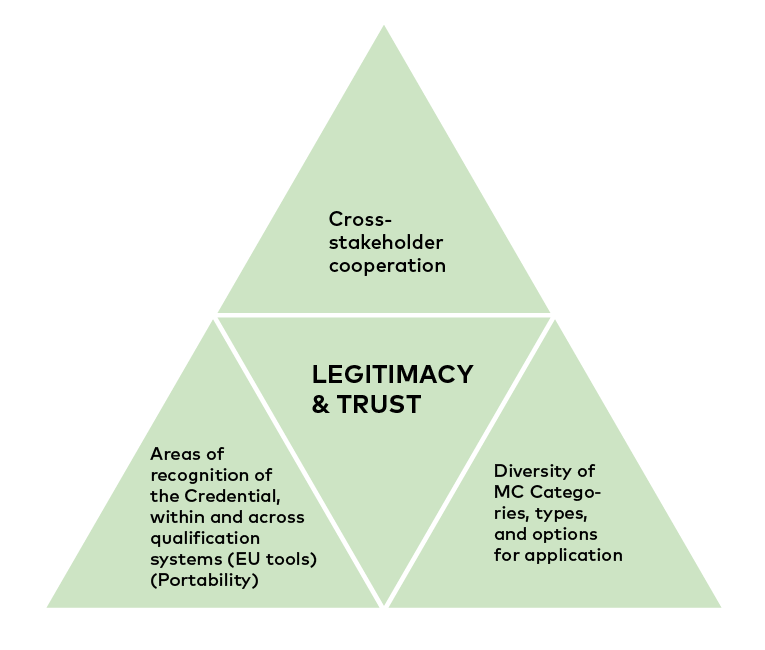 | The Legitimacy and Trust perspective of this model concerns the coherence of the factors: availability of MCs; diversity of categories and types, options for application; areas of recognition, the principle of portability and cross-stakeholder involvement. |
Ad model 2) Selection of the most appropriate MC depends on the availability of a variety of provided MCs, encompassing all relevant information of content and areas for recognition of the achieved MC and for application. This information and guidance should be available; for instance, in terms of websites of providers, stakeholder organisations or included in a national website for Education and Guidance. This perspective addresses a possible future situation of MC having proliferated and being implemented as a new option for learning in a variety of formats, models, aims and areas of application. Stakeholder involvement, whether in demands for skills, development of the MC or for collaboration on information and guidance, adds important aspects to the legitimacy and trust to the MC, especially in terms of a cross-stakeholder involvement due to various aspects of interest.
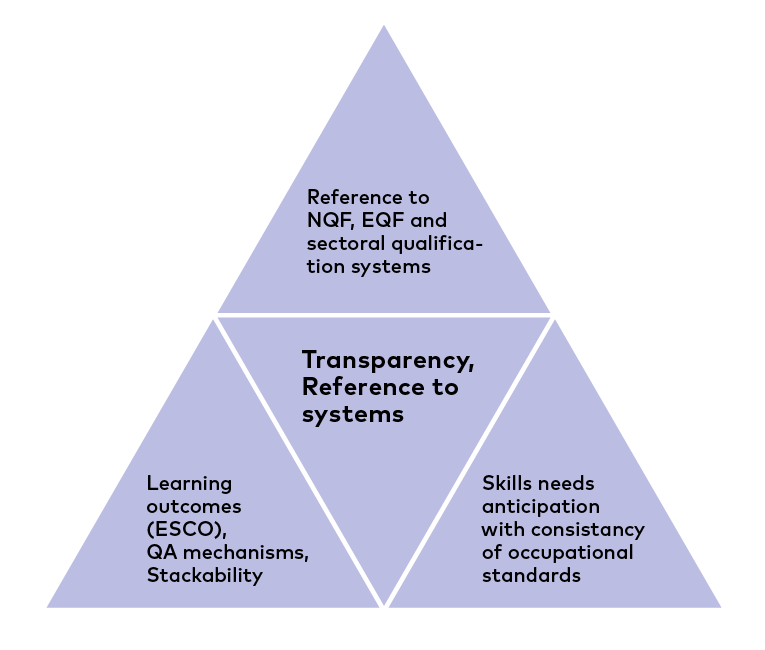 | The Transparency perspective of this model concerns the coherence of the factors: skills need identification or anticipation – consistency of standards; learning outcomes described in accordance with standards (ESCO or other kind of standards), Quality Assurance (QA), the principle of Stackability; Reference to NQF/EQF or to sectoral qualification systems. |
Ad model 3) The Transparency perspective of this model concerns coherency of the factors: skills need identification or anticipation – consistency of standards; learning outcomes described in accordance with standards (ESCO or other kind of standards), QA, the principle of Stackability; Reference to NQF/EQF or to sectoral qualification systems.
As model 2 concerns factors for importance of legitimacy and trust, the transparency perspective for model 3, adds similarly to the legitimacy as for identifying systematic, standards and criteria, behind the product of the given MC. Standards and criteria for skills need identification and anticipation, applied for the development of MCs, constitute evidence for the relevance of the provided MC and for the probability that the learning achieved is in demand and recognised within the given areas of application.
Likewise, the reference to established and recognised standards for the description of learning outcomes, thus also an aspect of QA, is a factor which moreover secures a reference to NQF/EQF and sectoral qualification systems with the possibility of stacking MC to a full and formal Qualification.
4.4. Partial conclusion
The point of illustrating these coherent factors of importance for added value and for the achievement of benefits for end-users is to stress the importance of all the aspects that contribute to making MC a valid and legitimate new format for learning and skills development. Potentially, two perspectives of this awareness of coherent factors could be applied to the future situation of MC.
One perspective is for developing the MC in terms of small learning formats and with a labour market focus for the benefit for end-users in achievement and application in the relevant context. Hence, this perspective offers MC being developed in terms of an infrastructure, securing quality in various means and aspects and to securing also the image of MC, being a valid and legitimate complementary offer, provided for flexible and just-in-time learning – so to say, MC in its own right.
The other, and a more future oriented, perspective, concerns development of a MC System, addressing the idea of an ECO-system. This perspective is already discussed, for instance as part of the extensive research project on MC, carried out by Cedefop for the EU MC initiative.
However, the idea of a MC System similarly raises a corresponding discussion about the status of MC versus Formal Qualification Systems. Parallel, independent systems? or two – mutual – permeable systems for a) securing the option of individual learning pathways and b) systems for formal education which probably also includes the provision of MC?
As a supplementary perspective to one overall system, with the inclusion of MC into the formal qualification system, the principle of permeability between systems would secure the option of stackability from part qualifications in terms of MC to a full, formal qualification. Thus, MC forming a complementary learning way within a structure for building your own learning pathway, from the MC system to be enhanced by the achievement of full qualifications, when needed and prioritised by the individual.
These perspectives are future oriented and require considerations within a multi-stakeholder collaboration and decisions taken by policy makers:
How should relations of MC and formal education be established?
- By development of a MCs system, referencing to formally agreed standards, criteria, systems for VPL and NQFs?
- By the application of other standards and criteria, agreed outside formal education, to form a coherent MC system and infrastructure and developed as a complementary way of learning?
- By a solution of two parallel systems, characterised by permeable openings for the learner, when relevant and desired?
Of importance for the solution of two parallel systems, characterized by permeable openings for the learner when relevant and desired, MC as a new format would demonstrate that Lifelong Learning and Continuing Education is not the same – but they can benefit each other.
The point is, that there is a risk for loosing profile and characteristics of MC while prioritising formalisation to formal systems and tools for the aim of securing recognition and the potential of Stackability. As for the formal educations, an approximation to MC – with the provision of small size learning units – risk fragmentising the coherent focus of education programmes when splitting up existing modules into several smaller modules, thus losing a distinct focus and profile.
In the mapping part of this project as well as in the Cedefop Survey on MC, it is seen as one of the dominating findings, that formal education, CVET, provide small learning units of modules split up into smaller units.
In the Nordic countries, modularisation of formal education has been a reality for many years. Modules forming a part qualification of the full programme are described in terms of delimited units, which thematically constitute a coherent and independent learning outcome. In some Nordic countries, it has recently become possible to provide a further modularisation into small size modules of 2.5 ECTS – formalised in the educational act.
To avoid fragmentation of the module –it being split into smaller units – some precautions must be made so to ensure a holistic and coherent profile of the small module. In previous evaluation of benefits of formal education programmes, it has been expressed that students may be challenged as to transferring learning outcomes from the education learning context to the context of application in job and daily work. This challenge might be even more difficult, while leaving it to the learners themselves to connect and to build the cohesion of learning outcomes of the entire programme when based on small size, individual modules.
Pointing at this risk is not for excluding the provision of small formal learning modules, but to advocate for the availability of guidance for the learners to develop their individual Learning Pathways – while benefitting, potentially, from all learning possibilities.