4. The lab phase: designing suggestions for solutions
In the lab phase the objective is to develop a design for new learning practices with the findings from the context phase as the starting point
In this process we focus on involving relevant actors that may confirm, challenge, or nuance our research findings and early ideas for solutions. Concretely, this entails a dialogue between the research team and several stakeholders and experts within digitalisation and working life, through the NVL Digital – Working Life network and by attending conferences. In these arenas we have presented tentative findings from the context phase, that inform the proposed design framework and our main ideas for a solution. Through design iterations (dialogue with network/conferences) we have developed a mock-up design for a new learning practice, that will be further presented below. In this way we have translated the research findings presented above to concrete suggestions for solutions.
Our mock-up is the result of iterative movements between the DBR model´s three first phases: the context, lab, and intervention phases, and is as such a collaborative result co-created by researchers, participants from practice/enterprises, experts, and stakeholders. The intention behind this mock-up is to contribute to enhancing Nordic enterprises´ current skills development practices within the digital transition, the level of digitalisation seen in enterprises and the opportunities of employees to take part in the future working life, by implementing a holistic view on change. However, it is important to highlight that the design of a final solution is not within the framework of this research project.
4.1. Methods we use in the lab phase
Vignettes
Vignettes are vivid and atmospheric brief stories created on the basis of empirical data (Dille & Plotnikof, 2020; Ericson, 1986; Jarząbkowski et al., 2014). During this research project we have made two vignettes that build on data collected via field visits to manufacturing plants in Denmark, Sweden, and Norway, as well as data from two virtual interviews with Finland and Iceland, respectively. The vignettes are small “portraits” that describe tension or topics that are specifically condensed or “vibrant” in the data set, which we during analysis have identified across geographical locations, job titles, and types of manufacturing enterprises. It is important to underline that they do not represent the reality of only one enterprise, or only one employee, but are constructed based on several data collections, impressions, informal chats with participants in practice, as well as stakeholders from the NVL Digital – Working Life network. They are furthermore informed by relevant theory on for instance identities or narratives.
Vignettes are powerful stories that offer authentic insight into the realities of participants and create a possibility for the reader to experience the field – at least partly. They are specifically valuable in the showcasing of muddled or entangled relationships between empirical themes and theory, as well as exposing data that is not text-based and thus more contextual, tactile, and emotional. Vignettes are inherently more than just reproduction of what has been said or seen; they are rather a theoretical retelling of a returning or “critical” topic.
In the development of our design idea vignettes are a part of a dialogue tool made available for enterprises in the digital transition, which will make enterprises capable of better understanding some of the local consequences of the change and thus develop strategies for continuing skills development as well as the creation of opportunities for employee participation in the transition.
4.2. Mock-up: vignettes as a dialogue tool in the digital transition
The mock-up in this first design iteration is shaped by two vignettes produced by the research team. The vignettes were developed immediately after the thematically inspired analysis (cf. previous chapter) and following a dialogue with the NVL Digital – Working Life network on the tentative findings of the research project. The topics of the vignettes were identified from some of the categories that the preliminary coding generated. The topics selected were, as discussed above, themes that were visible across data and thus created from several different contexts. There is not any specific employee/manager or enterprise that is the basis for the individual vignette. The vignette describes, rather, a topic that is identified across data sets.
The purpose of the vignettes is to create a dialogue tool for enterprises to support them in their understanding of the consequences of digital transition for employees and managers, and as such create an opportunity for enterprises to change, adjust, nuance, or re-prioritise specific initiatives or strategies for their local digital transition. As highlighted by the analysis, there are several organisational factors and new forms of organisation that have effects that may delay and speed up the transition, which is why it may be interesting for enterprises to be curious about these factors.
The dialogue tool is to be viewed as a local in-house initiative and supplement to sending employees to upskilling courses, and as a way for employees and managers to relate critically and reflectively to opportunities as well as challenges in an enterprise´s transition. It is a tool that aims to create shared scenarios on the future and support the digitalisation level of enterprises by involving employees as informed and resourceful actors with deep knowledge on local transition practices. In this way both employees and managers may “be ahead” of the development, and employees may play an active role by contributing with solutions and ideas for improving the various parts of the transition. Potentially, it creates fertile ground for innovation and growth, as well as more possibilities for participation, that may have a beneficial impact on employee well-being. The tool thus contributes to creating a collective awareness of the digitalisation level of the enterprise and the possibilities for employee influence. It furthermore supports another point of the analysis, which is that enterprises should have a broad repertoire of strategies when planning and making priorities on future digital transition.
TRANSITION TIP
The dialogue tool is to be viewed as a local in-house initiative and supplement to sending employees to upskilling courses, and a way for employees and managers to relate critically and reflectively to opportunities as well as challenges in the enterprise´s transition.
The dialogue tool is to be viewed as a local in-house initiative and supplement to sending employees to upskilling courses, and a way for employees and managers to relate critically and reflectively to opportunities as well as challenges in the enterprise´s transition.
The testing of the first iteration of the vignette tool (unfolded in the next phase) identified a need for a version of the tool that gives the possibility of creating concrete local stories. Based on this, the tool developed into having two parts: 1) a dialogue tool with “generic” vignettes produced by the researchers, and 2) an invitation to explore the stories of the individual enterprise. The first iteration thus resulted in our concrete development of a mock-up of the dialogue tool´s use and design.
4.3. Suggestions for the dialogue tool´s use and design
The tool is designed for concrete use in practice and can be applied for instance in performance and development interviews or other “meetings” between employees and managers. The tool can be used across the manufacturing sectors, and it is as such not developed for a specific industry. It is applicable for all types of enterprises that are in the middle of a digital transition process, and which are seeking knowledge on some of the local circumstances that may influence the process, positively and negatively, as well as on how to ensure the participation of all employees to create and profit from a more extensive employee endorsement. The tool has an inherent perspective on the future, as it aims to support employees and managers in their collaboration to achieving a deeper knowledge of the consequences of digital transition. The goal is to sharpen the future connections between practice knowledge “from the floor” and the strategic ambition “of the offices”.
The dialogue tool consists of two elements that taken together constitute a “package” that will support the digitalisation level of enterprises and employees´ opportunities for continued participation in a digitalised labour market. The individual elements can be applied on their own or used as a two-step rocket. The dialogue tool consists of:
ELEMENT 1: Evidence-based vignettes on the working life during a digital transition, where managers and employees jointly read and discuss one or several selected vignettes. In its final version the tool consists of 10 pre-produced vignettes that, based on research on digital transition in the working life, address various topics and tensions related to this transition. The manager and employees jointly select the/those vignette(s) that seem relevant, for the employees or the manager, for the specific company circumstances of which they both are a part. The vignette aims to create a dialogue on some of the possibilities and challenges that may be difficult to spot or discuss during a hectic workday. An important point related to this element is that the vignettes are not personal stories, but stories that according to research relate to a reality. This is important since it offers the opportunity to discuss difficult or muddled themes that an employee may not want to be associated with one´s personal story, but that still are legitimate stories since they contain topics and tensions that are identified by research within that domain.
Evidence-based vignettes
Stories as effective drivers (employee and management perspective)
Organisations sometimes contain “stories” about management or a specific group of employees. These are stories that are told and shared by everyone, often without an actual owner or a clear messenger. They are abundant in formal and informal happenings like for instance during coffee breaks or over lunch, like jokes, in meetings, or just as “internal” stories in people´s heads. Often, these stories convey implicit prejudices that influence how we see or understand each other.
Linked to the digital transition there are specific stories about senior employees or unskilled factory employees. These are stories told by both management and colleagues, describing these employees as uncommonly “conservative”, as someone who struggles with the digital transition, and often as someone who is not equipped to handle new technology. These are stories that narrate a general resistance from employees “on the floor”.
Stories that are told in organisations may both delay and speed up the digital transition. For enterprises in a digital transition, it can make sense to be curious towards the stories we tell ourselves and each other, because they are effective drivers that can create delays by for instance intensifying feelings of resistance. However, they can also advance the transition, in the purposeful work to change implicit and explicit prejudices that influence strategic decisions or the development of new routines or practices.
Professional identities under pressure in the digital transition (employee perspective)
Organisational changes affect many aspects, routines, and practices: the way work is being done, the cooperation between colleagues, the management and communication style, etc. Dependent on the magnitude of the change, it may also influence the way we assess our own skills and competences, which may determine our feeling of belonging in the workplace. It is specifically challenging if our work tasks from one day to the next suddenly require something from us that we cannot give yet. In those situations, we can discover that our professional identities come under pressure.
During the digital transition organisational changes are often perceived as comprehensive and “radical”. For employees these changes often entail a growing number of work tasks being taken over by machines. Alongside this change new skills are required, that may seem irrelevant to one´s profession and altogether alien. Sometimes these requirements may result in employees feeling “homeless” in their usual work. They may experience a loss of legitimacy or identity because their expertise and insight are no longer acknowledged as valuable. Suddenly they are not experts anymore, but novices.
Organisational changes are inevitable, and they will always influence concrete work tasks. However, they may also influence the identities of employees who see their tasks being radically changed. Enterprises facing digital transition may find it meaningful to discuss the employees´ potential identity pressures when planning for skills development and consider whether other requirements than technical courses are needed.
ELEMENT 2: Exploring local practice stories is an invitation to managers and employees to explore the stories in their own enterprise. It is an invitation to behave like an anthropologist and be curious and investigative about specific topics – large and small – that can be found in local practice, for instance inappropriate or contra productive rhythms and sequences. The tool contains a template with room for comments, ideas, and reflections on specific topics that employees and managers agree on together. Furthermore, it offers an opportunity to write down any agreements on follow-up or other issues that are expected to be handled later. The objective of this exploration is to give both parties an opportunity to achieve insight into what goes on locally. Compared to element 1 (above), that element is concerned with “what goes on” generically, and as such does not necessarily address topics that are relevant locally. This second element in the vignette tool requires a great deal of trust between management and employees on agreeing that the focus of the exploration will be “the issue” (i.e. the transition), and not employee performance. Therefore, it may be beneficial to start with element 1 before the local exploration.
Exploring local practice stories
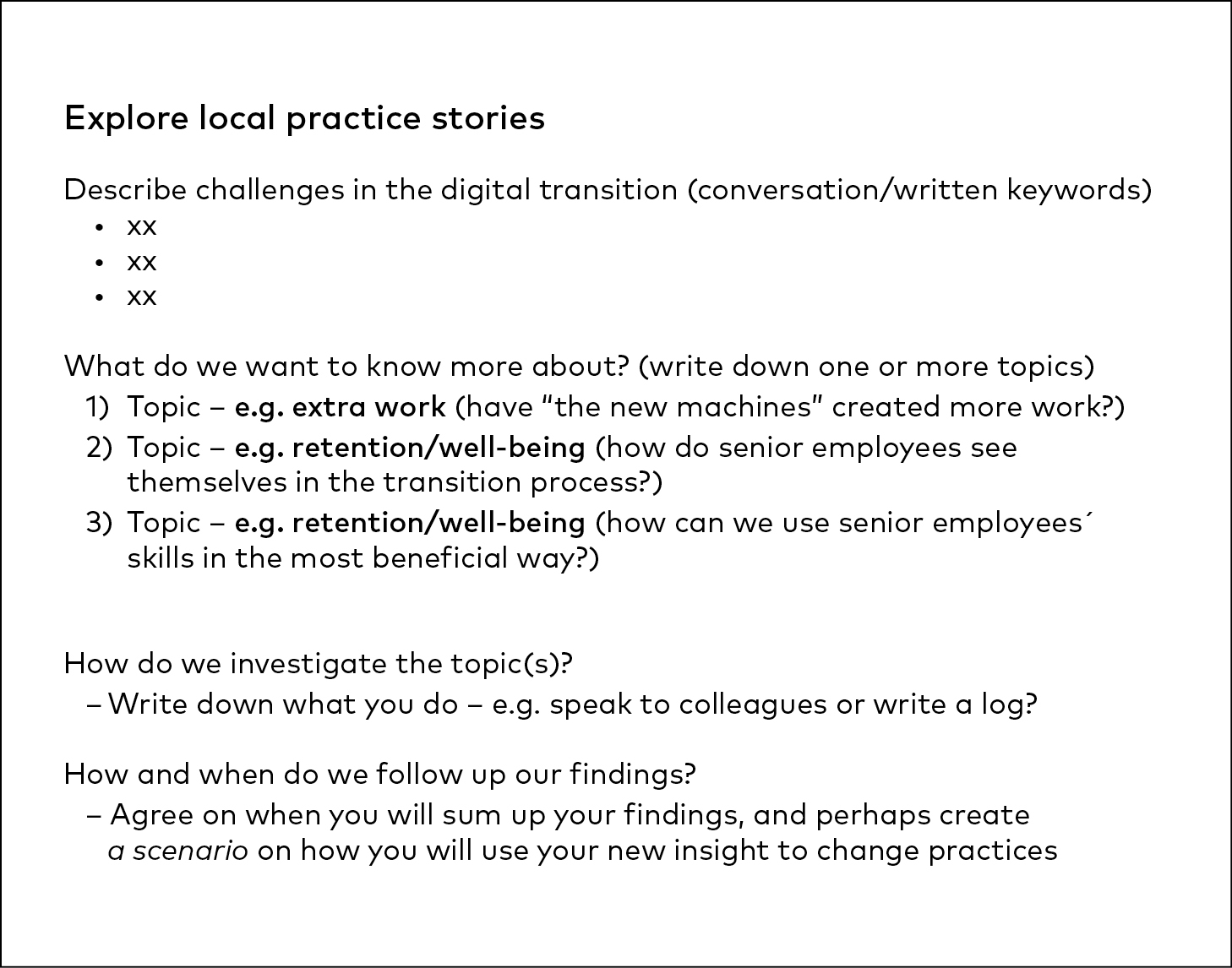
Figure 10 Support questions for local practice stories