2. Research design: Design-based research (DBR)
The research project aims to identify problems and develop solutions
In DBR various stakeholders come together to play an essential role in the research phases. The rationale behind this is that the actors of the practice field possess important experiences and knowledge that contribute to the progress of the research. Furthermore, DBR is a research approach that simultaneously explores and intervenes in professional practice aiming to develop new learning and new solutions. Thus, DBR consists partly of collaborative problem identification, and partly of the development of alternative solution proposals, that are tested. Both activities take place in cooperation with relevant stakeholders. Consequently, DBR is an alternative to research designs that are interpretive or that test hypotheses. The approach was originally developed to implement digital technologies in the education sector and other professional sectors (Amiel and Reeves, 2008). The double focus of the methodology on investigating and intervening makes it suitable for high-complexity practice fields. The DBR approach implies that the present project is based on the following principles:
Pragmatic and applicable: focus on concrete problems in practice
Description: Within DBR the starting point is that knowledge is validated through its applicability in practice. This means that the learning that is being developed must stand its ground when facing the practice that is being researched.
Example: The present project is developing learning about employees´ and managers´ knowledge and experiences with challenges and opportunities linked to digital transition. This learning is validated through their feedback on the usefulness of the proposed solutions.
Collaboration as a decisive point
Description: Collaboration is the decisive point of DBR. This means that the involvement of a variety of actors from relevant fields of practice and other stakeholders is essential. They are all considered partners with valuable insights. This is true for the initial phase, when problems are identified, and later, when offering feedback on suggested solutions and in evaluating mock-ups when these solutions are tested in practice.
Example: In the present project we work in a collaborative manner when we during interviews and company visits ask actors belonging to the practice field to describe and point to opportunities and challenges linked to their specific roles in digital tasks, and later use this input in the continuing development of the project´s research questions and possible solutions.
Iterative processes: problem, development, testing, evaluation, analysis, and improvement
Description: DBR is characterised by iterative processes that intend to continue improving suggested solutions, making them as robust as possible and applicable in various contexts.
Example: In the present project we work in an iterative manner when we design and redesign solutions. This may happen when we for instance ask for feedback on vignettes (short stories produced by researchers; discussed in chapters to come), which is used as a basis for further development and improvement.
Theory-oriented – generalisation
Description: DBR is not only used to solve concrete problems. The research approach also creates new learning on the problem identified, that can be generalised and contribute to the development and nuancing of existing knowledge. Investigations and analyses are always theory-oriented. This means that they build upon existing and domain-specific knowledge within a given field. They look to the interpretative sciences when identifying and understanding a problem, and design theory when initiating ideas and solutions. Lastly, but not least, theory is used in verification, when a solution´s validity is tested in practice.
Example: In the present project we work in a theory-oriented manner when we apply socio-material concepts to analyse and understand the complex situations that we meet in concrete practice contexts. This may for instance happen by focusing on the enterprises´ various material circumstances, like physical objects and spaces, or specific habits of and cultures in a workplace, that contribute to the specific design of work processes.
Intervention in practice
Description: DBR intervenes in practice since the solutions developed are also tested in a practice context. Consequently, new solutions influence existing practice by offering new ways of solving problems. In DBR intervention in practice aims partly to improve existing practice, and partly to develop better theories on practice.
Example: In the present project we intervene in practice when we offer solutions to practice actors in the form of vignettes, which may lead to new ideas on how to organise skills development. A narrow digital focus on specific digital skills is replaced by a holistic view on a digital workplace.
DBR is a wide research approach. This means that there is not one fixed method or design of how to develop the project. However, most DBR-projects work according to some well-established phases. For the present project (reports 1 and 2 inclusive) we have developed a four-phased research model, drawing inspiration from Amiel and Reeves (2008), that simultaneously applies a circular progress in phases and an iterative progress to improve learning and solutions.
The methodological considerations of the project are presented below, including methods, criteria for recruitment of participants, and an overview of the total dataset.
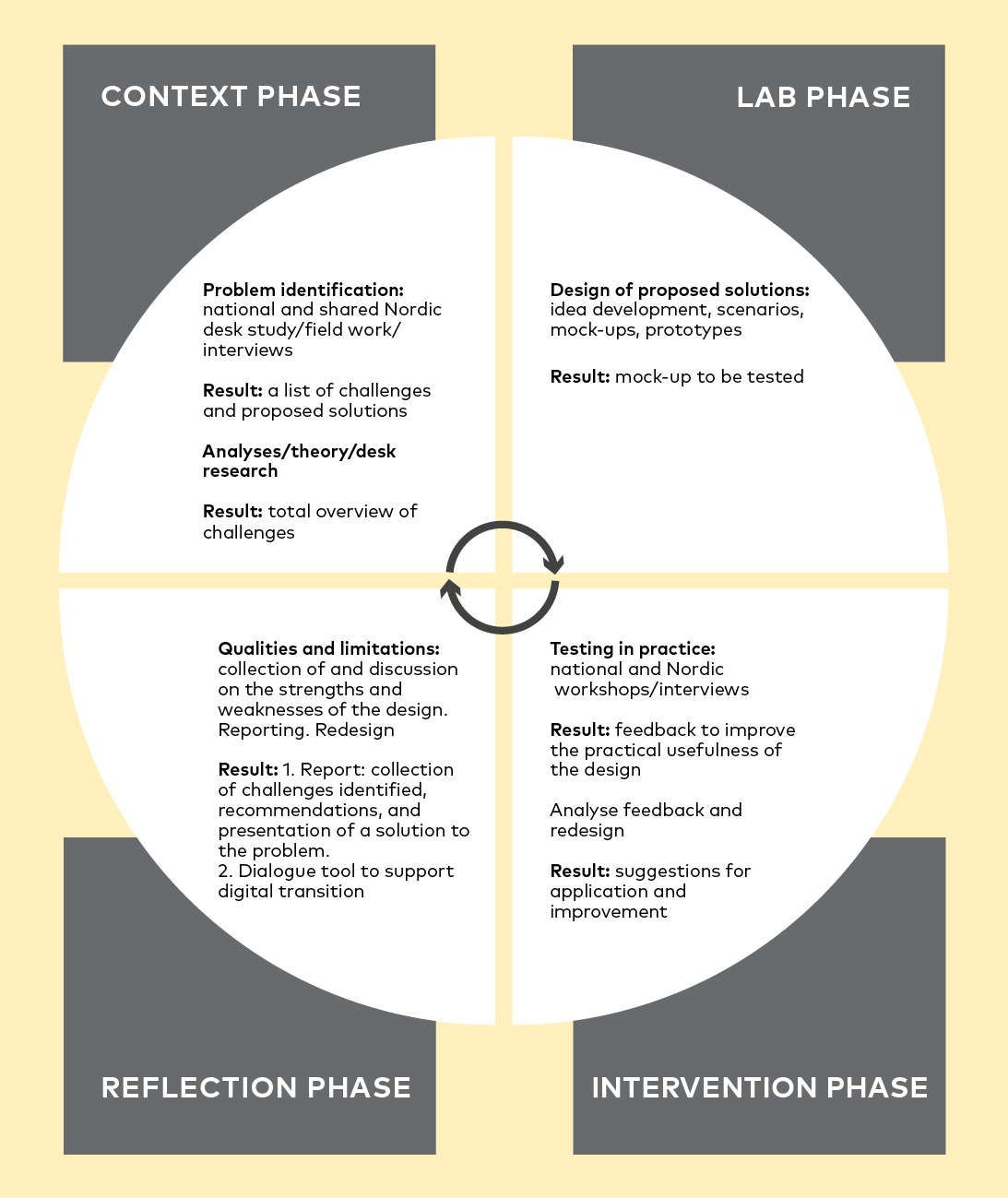
Figure 1 DBR model
2.1. Methodological considerations: cooperation, generating knowledge, and recruitment
Research cooperation implies a development of methods and generation of data based on “real life”, i.e. the daily practices of the participants. It is thus a method within the DBR approach that is inspired by ethnography (Marcus, 1995), and primarily entails an engagement with reality by the researchers during the context phase. This means a placement in practice to obtain information about some of the complex connections that digital technologies are part of during a workday. It also implies that the insights and experiences of the participants (here: employees and managers) are viewed as valuable testimonies and contributions. In this way, participants are recognised as co-creators of knowledge on the challenges of digitalisation and contribute with solutions by highlighting possible alternatives for future policymakers, organisations, managers, and employees when making priorities and navigating the digital transition of the working life.
The aim of this ethnography-inspired method in the current project has been to create an extensive knowledge base on practice and with practice across the Nordic countries. The investigation has included several geographical localities across country borders, not for comparison, but rather with the aim of developing a rich and empirically nuanced description of the digital transition in the Nordic countries. As such, the project draws upon logics and understandings from the methodological approach multi-sited ethnography (Falzon, 2016), which is precisely characterised by the investigation of phenomena – in our case, digitalisation – across geographical locations, contexts, and practices.
Recruitment of participants from the working life
As our empirical limitation, as described above, relates to small and medium-sized enterprises within the manufacturing sectors, we have targeted companies in the five Nordic countries that fall within this limitation, and which have experience (limited as well as extensive) with digital transition. We are aware that enterprises develop in different tempos, however, in the current report we have not made our recruitment based on a categorisation of enterprises´ digital level (e.g. industry 3.0 or 4.0) and thus their estimated competitiveness. Rather, our research has focused on how entanglements between people and technologies unfold in the specific enterprises, regardless of how “far” they have come in their transition.
Since we have been concerned with creating a diversity of perspectives and reflections on the digital transition of working life, we have not made any further limitations on types of enterprises within the manufacturing sectors. Consequently, the enterprises with which we have cooperated vary considerably in terms of what products they manufacture. However, all of them work within some form of industrial production.
Besides the empirical limitations mentioned above the research team has made selection criteria related to analytical selection (Halkier, 2010). This implies that our selection has ensured a diversity of perspectives that are expressed through the participants´ roles in the enterprises as well as their various interactions with digital technologies in their daily work. As such, we have recruited “widely” and cooperated with both skilled/unskilled employees with direct experience from digitalisation as well as middle managers/managers. The latter employee group demonstrates different experiences with and perspectives on digital transition but is still relevant since middle managers/managers often carry the responsibility of making priorities, managing, and making strategic decisions on the implementation and maintenance of digital technologies. As such they shape the circumstances for how technologies are applied in the enterprises.
The research project has cooperated with one enterprise in each Nordic country. In some of the countries we have conducted limited fieldwork with observations and informal chats with middle managers/managers and employees, while other countries have seen interviews (discussed in the next chapter) with middle managers/managers and employees, respectively.
NVL Digital – Working Life and the reference group as gatekeepers
In the recruitment of enterprises members of the NVL Digital – Working Life network and its associated reference group have acted as national gatekeepers, to ensure a broad Nordic representation in the research project. Concretely, the members´ assignment has been to contribute to the facilitation of contact with local enterprises in their respective home countries. In Norway, Finland, and Iceland members of the network or the reference group have introduced the research team to manufacturing companies, followed by the developing of cooperation agreements by the researchers. In Sweden and Denmark, the researchers have used their own networks to develop the cooperation. Taken together this has contributed to the research team´s desired variation in types of production, differences related to national and international markets, geographical location of enterprises in and outside capital cities, as well as a heterogeneity in enterprise size from micro, via small, to medium-sized, based on the number of employees (1–249).
2.2. The research project´s database
The results of the research project are generated based on cooperation with the practice field in various contexts during spring and autumn 2022. The next chapter will discuss the specific characteristics of the contexts and the data generated; however, the data is also briefly listed below:
Fieldwork (observation and informal chats): Limited fieldwork was conducted in three Nordic countries (Denmark, Norway, and Sweden) with various participants from the working life, including skilled/unskilled employees as well as middle managers/managers. Three to six participants took part from each of the three Nordic countries:
- Data in the form of observation notes;
- Data in the form of photos;.
- Data in the form of email correspondence with the enterprises concerned.
Virtual interviews: Two rounds of in-depth interviews were conducted. The first round took place during spring 2022 and consisted of two interviews of an hour´s duration each across two Nordic countries (Iceland and Finland), with two different employee groups. In one of the interviews two skilled/unskilled employees from different types of enterprises in the two countries participated. In the other interview one middle manager and one manager from different types of enterprises in the two countries participated. The second round of interviews were conducted during autumn 2022 and consisted of five follow-up interviews with two of the four persons from the first interview round (Iceland and Finland), as well as three persons from field visits in Denmark, Norway, and Sweden. Data from the interviews consists of:
- Video data from interviews;
- Data in the form of observation notes from interviews – from interview round one exclusively (created by a researcher).
Summaries from dialogues with NVL Digital – Working Life and reference group: continuous presentation of findings and feedback.
Vignettes: two research vignettes (brief, empirical narratives from the field) have been developed. These address a topic identified by the research. The vignettes are created from the total data set and are developed as a part of the research project's suggestion for a solution. The vignettes may be used as a tool for stakeholders in digital skills development (unfolded below in the lab phase). The vignettes thus constitute both the data of and the solution to the project.