2. Learning circles
Learning circles is a term for gatherings of participants that examine various events or subjects over a longer period of time using varied forms of meeting.
What is a Learning Circle?
The circle as an arena for collective learning has several applications. It can be used in different workplaces both as a way to develop skills and to develop businesses. Solving shared work-related issues and dilemmas, and staff collaborating on the basis of different outlooks and roles, are all important factors when establishing a circle. Study circles are also used to read literature or educate groups in a particular field of knowledge. In your leisure time, you may encounter circles that have been formed to gather people with similar interests, such as cultural activities or other personal interests. In principle, anyone who wants to participate in a circle can do so regardless of their background or age. Common to all is that the circle is a long-term gathering that depends on continuous participation.
Types of Learning Circles
Circles aiming to facilitate various kinds of collective learning can be divided into three different types in the adult education context: study circles; transformative learning circles; and research circles.
A) Study circle
This is a form of learning circle that usually has a pre-defined syllabus and reading list in place. The purpose of the circle is to study a subject (e.g. language, ideology, a book) or problem with the help of a teacher/leader and suitable literature.
B) Transformative learning circleTransformative and intercultural learning have common characteristics. Encountering different or alternative interpretations and perspectives increases opportunities for reflection and learning. A Nordic circle with participants from different countries and organisations forms the basis for both intercultural (Lahdenperä, 1999) and transformative learning. In a Nordic circle, it is possible to compare different countries’ policies, social systems and practices, which naturally increases knowledge of and insight into the significance of the context in relation to the relevant area of knowledge.
Transformative and intercultural learning have common characteristics. Encountering different or alternative interpretations and perspectives increases opportunities for reflection and learning. A Nordic circle with participants from different countries and organisations forms the basis for both intercultural (Lahdenperä, 1999) and transformative learning. In a Nordic circle, it is possible to compare different countries’ policies, social systems and practices, which naturally increases knowledge of and insight into the significance of the context in relation to the relevant area of knowledge.
This is a form of learning circle that aims to promote more specialised and transformative changes in practice.
C) Research circle
The research circle differs from the other circles in that the circle is characterised by a research-led approach. Research circles are based on the principle of mutual exchange between researchers and practitioners, with activities in the circle being based on research-focused activities. As a method, the research circle’s origins lie in practice-based research and action research. In connection with academia’s so-called “third task” – public outreach – the research circle has become a popular method among researchers in Sweden.
Characteristics of Practice-based Learning Circles
Common to both transformative circles and research circles is that they aim to develop practice. Their methods and theoretical points of departure draw inspi-ration from participant-based research traditions and/or lifelong education. Key characteristics of participant-based learning circles, such as research circles, are:
- They are based on participation and the individual’s existing understanding, proficiencies and values. The point of departure is a learning process in which participating individuals in a group seek to examine how knowledge is shaped by perceptions of different realities and the importance of context to their interpretation.
- They are based on critical thinking and reflection.
- They aim to change both theory and practice and to create new knowledge and skills.
The purpose of learning circles/research circles is therefore to cast light on problems and issues in participants’ daily lives from a number of different angles before finding solutions to the given problem. The work of the circle is thus rooted in the participants’ own dilemmas and everyday problems. Working with everyone’s contributions in the form of different experiences and knowledge entails the creation of something new – this is a mass of knowledge that cannot be formed in isolation by practice or research alone.
Working with Learning Circles in Adult Education Contexts – Idea Base and Learning Processes
Learning circles are frequently used in adult education contexts and for skills development. In terms of theories relating to adult education and skills development initiatives, Donald Schön’s The Reflective Practitioner (2003 [1983]) has been a key source of inspiration. He argued that most knowledge used by professionals in practice is not taken from any textbook. When Schön seeks an epistemology for practice, he instead identifies the significance of action and reflection to professional development. The important thing in relation to the learning is therefore that experiences are subject to critical scrutiny and reflection, which is made easier when this occurs collectively in a circle. The collective work in a circle enables the co-creation and innovation of knowledge.
Learning Processes in Practice-based Learning Circles
The focus in a learning circle is on the significance of the action and reflection to professional and knowledge development, which can also lead to the development of practice and the organisation. As such, learning in a circle can be described as a process where:
- experiences related to the focus area of the circle are the starting point for the
- reflections and conclusions that are then
- specialised through the use of theories and models. Being able to make
- new conclusions requires reflection and critical examination within the circle.Learning should lead to new experiences, where action in practice gives rise to new
- experience and skills (see image).
LEARNING PROCESSES IN A CIRCLE
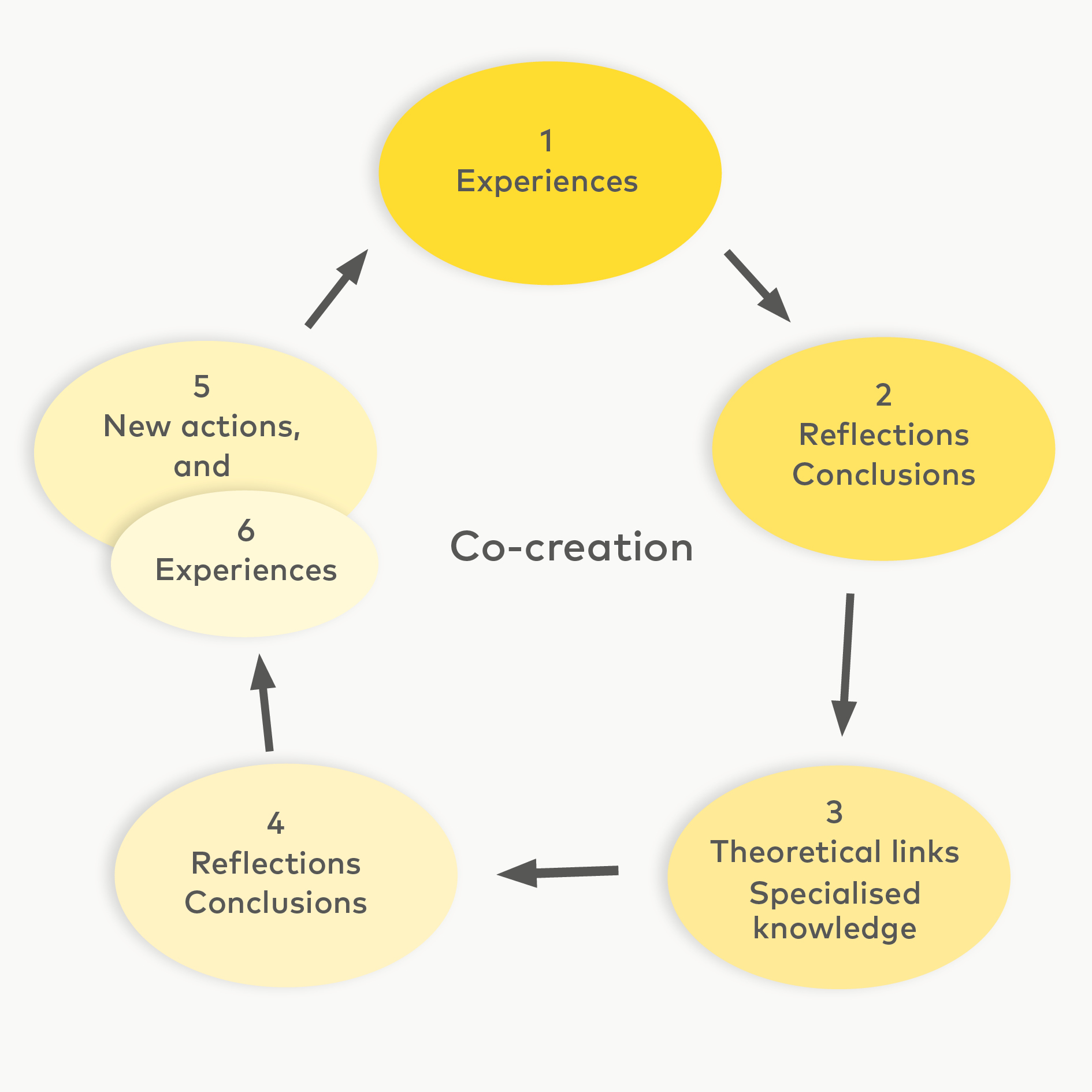
Learning in the circle is characterised by a process – a long-term, collective learning process – that may result in qualitative changes to participants’ competences and ability to change their practice. Collective work as part of the group enables both inquiry and co-creation.
Co-creation is “understood as a process of interpersonal interaction, involving relations, communication and leadership, aiming at innovation, i.e. at creating new values” (Dorsø, 2014). Bovill (2014) emphasises increased engagement and motivation, awareness of meta-cognitive perspectives and enhanced learning experiences and enhanced learning experiences as some of the qualities of a co-creational approach to learning and teaching. In a co-creation approach, participants are addressed not as receivers of information, but as shapers of knowledge and all participants are perceived as experts and diversity is valued.