The Nordic way
The social partners have an active role in the Nordic skills agenda
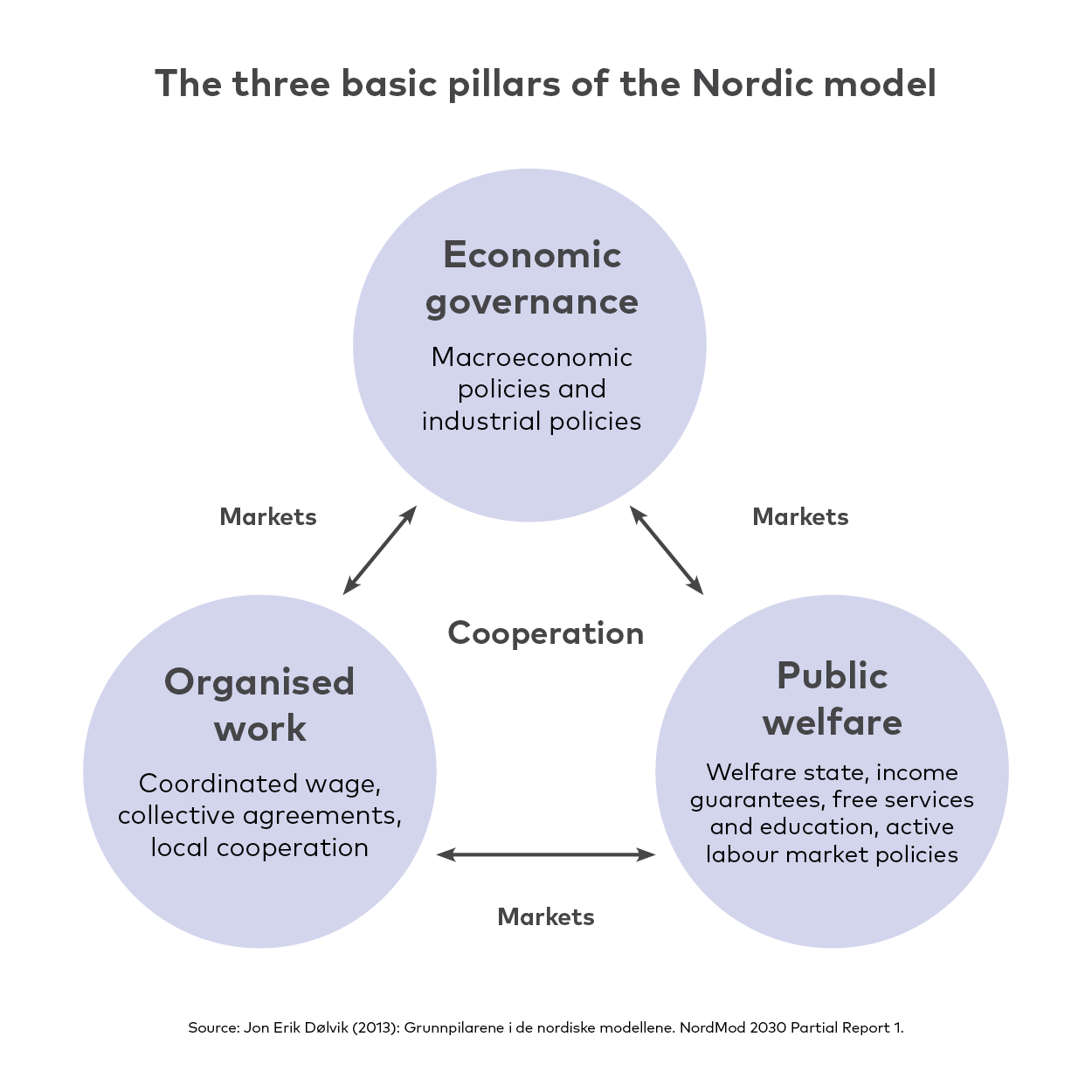
According to the European research institute Eurofound, the social partners should have an active role in skills development. The involvement of the social partners could ensure that an organisation’s technological development is rooted in human-centric values (2021). Social partners can help determine which AI technologies to adopt – and how. They can facilitate introduction and implementation as well as define training needs. Previous OECD analyses show that social dialogue and collective bargaining play crucial roles in changes in working life, by easing transitions and spreading best practices. OECD surveys show that trade unions are most concerned with ethical issues, while employer organisations focus on new skills requirements (OECD 2023).
A larger part of the population are members of trade unions in the Nordic countries than in the rest of the world (Logue 2019). The social partners are involved in lifelong learning in all Nordic countries: in Iceland, the Education and Training Service Center is a coordinating body for 14 regional lifelong learning centres. The organisation is owned by the social partners and the authorities (atvinnulífsins).
There are tripartite agreements regulating continuing education in both Denmark, Sweden, Norway and Finland: in Sweden and Denmark, in 2021 and 2023, respectively, the social partners signed tripartite agreements on continuing education and training for working life (Cedefop 2021; Undervisningsministeriet 2023). The social partners collaborate actively with the government to shape policies and strategies for adult education in Finland. This ensures that the education system aligns with the needs of the labour market and society (Kuusipalo et al. 2021). Among others, the social partners are involved in a continuous learning reform in Finland (Culture 2019).
The tripartite industry program in Norway (Bransjeprogrammet) was established in 2018, as a grant programme in which the social partners describe the competencies and skills needs (HK-dir 2024b). The authorities pay for the development of new courses and education. Employers give their employees time off to attend courses and the employees themselves spend some working hours and some private time to participate in skills and competencies development.
Well-established lifelong learning systems in the Nordic countries
The five Nordic countries have well-established public systems for lifelong learning, including general, vocational as well as continuing education and training (Berggren 2024). They also have rather updated skills strategies and analyses of skills needs. This is helpful when it comes to ensure that the population’s skills match the needs of working life. In addition, all five Nordic countries have systems for career guidance and validation of prior learning (NVL 2023).
 | In Sweden, employees in the middle of their working life, who want to study to develop their skills, may apply for transitional study support (omställningsstudiestöd) (CSN, 2024). Also, the Swedish Parliament has implemented a comprehensive reform for upper secondary schools and municipal adult education. This reform includes new regulations for planning and structuring upper secondary education (‘Planering- och dimensionering av gymnasial yrkesutbildning’) (Skolverket, 2024). |
 | The reform of continuous learning (Reformen av det kontinuerliga lärandet) in Finland also responds to skills needs (Finland 2023). |
 | There is a reform in higher education in Denmark with shorter variants of master studies and a continuing vocational education programme (Science 2024). |
  | In Norway, the modulization of adult learning, piloted from 2017 until 2024, has now become a permanent system (HK-dir 2024a), while one of the pillars in the strategy Education Policy 2030 in Iceland is skills for the future (OECD, 2021). |