- Publish Date
- Country
- Norden
New opportunities for international PIAAC research
Artikel
How to access data from multiple countries?

Her finder du artikler fra netværket PIAAC.
Artikel
How to access data from multiple countries?
Artikel
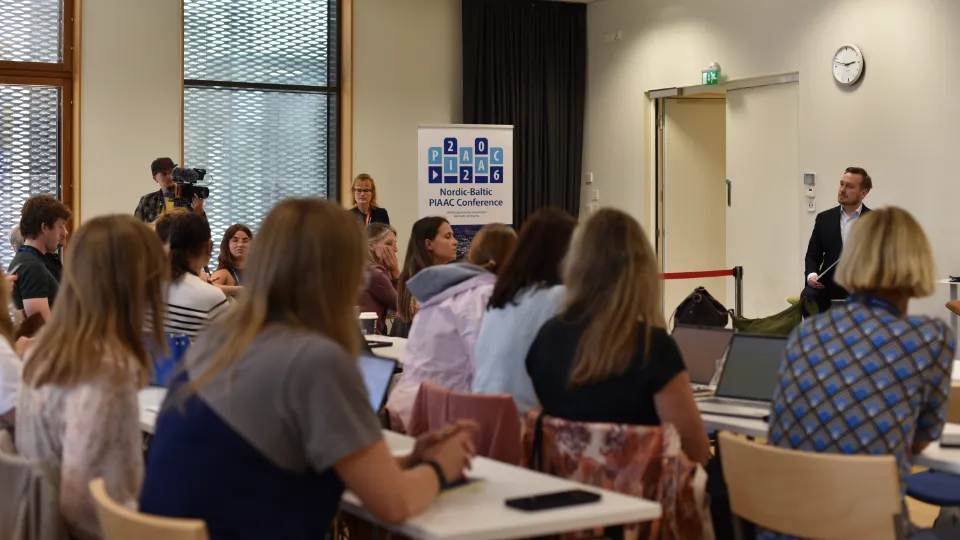
What skills do we need in a changing society and world of work? The Nordic-Baltic PIAAC Conference explored foundational skills, participation and learning.

Artikel
In August, researchers, policymakers and practitioners will meet for the Nordic-Baltic PIAAC Conference 2026, where they will discuss what the OECD’s survey of adult competencies means for the labour market, education and lifelong learning of the future.
Artikel
I august mødes forskere, beslutningstagere og praktikere til den nordisk-baltiske PIAAC-konference 2026. Her skal de sammen diskutere, hvad OECD’s undersøgelse af voksnes færdigheder betyder for fremtidens arbejdsmarked, uddannelse og livslange læring.

Artikel
Danske voksne er gennemsnitligt blevet bedre til både at læse og regne sammenlignet med for ti år siden. Det viser resultaterne af den internationale PIAAC-undersøgelse. Danmark ligger dog lavere end de andre nordiske lande, og andelen med færdigheder på det laveste niveau er ikke blevet mindre.

Artikel
De vuxna finländarna är bäst på att läsa och räkna bland alla 31 OECD-länder som deltog i den internationella undersökningen PIAAC. Landets framgångar speglar inte bara en stark utbildningstradition, utan även att goda färdigheter är kopplade till både förnöjsamhet med livet och tillit till andra.

Artikel
Et enormt datamateriale om kunnskapsnivået hos voksne foreligger i PIAAC2-undersøkelsen. Hovedresultatene kan oppsummeres på fire linjer, men det er mye, mye mer å hente i resultatene fra store intervjuer med 4000 respondenter (Norge) i alderen fra 16 til 65 år.

Artikel
Sverige toppar OECD:s PIAAC-undersökning, men unga vuxnas läsfärdigheter försämras – särskilt bland utrikes födda. Studien bekräftar vikten av utbildning för jobb, ekonomi och hälsa. Skolverket arbetar för att språk- och läsundervisningen kan bli bättre inom sfi och komvux.

Artikel
Data from the PIAAC surveys provide rich information about adult skills in literacy, numeracy and problem solving, and how adults use their skills at home and at work.
Artikel
The Programme for the International Assessment of Adult Competencies (PIAAC) is an OECD survey measuring key information-processing skills in literacy, numeracy and problem solving among the adult population aged 16–65.

Artikel
PIAAC measures key information processing skills and data from the survey provide unique opportunities to analyse the cognitive skills needed in the labour market and society. Access to PIAAC data, on its own or linked to register data, is possible for research purposes. To facilitate the selection of register variables a handbook is available for…

Artikel
People with low skills in respectively literacy and numeracy are defined as those who are at level 0 and 1. These people score less than 226 points at the scale of literacy and numeracy respectively, a scale ranging from 0 to 500. Persons at level 0 and 1 in literacy are able to read and…

Artikel
In this article, the Danish sociologist Anders Rosdahl presents main findings from PIAAC cycle 1. The article presents skills in the Nordic countries in a comparative perspective and focuses on the uneven distribution of skills with regard to education, age and other factors. It also sheds light on adults with low skills and how adult…

Artikel
The report presents comparative results from PIAAC cycle 1 for Denmark, Estonia, Finland, Norway, and Sweden. It supplements national and international PIAAC reports by comparing the results from five countries, as well as comparing an aggregate of these countries to other country aggregates with regard to skills in numeracy, literacy and problem-solving.